|

Showing posts with label American Revolution. Show all posts
Showing posts with label American Revolution. Show all posts
Thursday, March 22, 2018
Hidden History: Lower Manhattan Walking Tour


Thursday, November 16, 2017
Postcard Thursday: The Battle of Washington Heights

Should you find yourself in Washington Heights, stop by Fort Tryon Park (home to the Cloisters); today marks the 241st anniversary of the battle of Fort Washington, where 3,000 Hessian troops and 5,000 British regulars overwhelmed the American troops.
In the fall of 1776, the Americans were on the run. They'd abandoned Lower Manhattan in September and despite a minor American victory in Harlem Heights on September 16, George Washington's troops were then routed at White Plains on October 28. In the wake of that loss, Washington ordered General Nathanael Greene to abandon Fort Washington in Upper Manhattan and head to New Jersey. However, Greene and the post's commanding officer, Colonel Robert Magaw, convinced Washington that the fort was defensible. That turned out to be a grave miscalculation, in part because one of Magaw's soldiers, William Demont, turned out to be a traitor, and had already given the British details of the fort's defenses.
By the end of the battle, 59 Americans had been killed and nearly 3,000 taken as prisoners of war. Many of these prisoners would subsequently die in the fetid conditions of British prison ships in Wallabout Bay, Brooklyn.
One American killed was John Corbin. His wife Margaret, a nurse who been allowed to join the soldiers in the fort, took his place at his cannon and continued firing until she was gravely injured. She never fully recovered from the wounds she received that day and later became the first woman to receive a military pension.
Fort Washington itself stood where Bennett Park sits in Washington Heights. After the British victory, the fortifications were renamed after Sir William Tryon, the British governor; today, the main road in Fort Tryon Park honors Margaret Corbin.
* * *
Thursday, May 25, 2017
Postcard Thursday: The Ratzer Map

250 years ago, Lieutenant Bernard Ratzer set off across Manhattan and Brooklyn to make the first -- and still, in many ways, best -- comprehensive map of New York City.
A few months ago, James walked in Ratzer's footsteps, looking for traces of the city as it would have been two and half centuries ago. You can read the results in this piece he wrote for Curbed this week, "A Walking Tour of 1767 New York" (https://ny.curbed.com/2017/5/24/15681406/bernard-ratzer-map-new-york).
Speaking of walking tours, we'll be hosting a public tour on Sunday, June 25, so save the date. Details coming soon!
* * * *
Read more about NYC history in
  |
Thursday, September 22, 2016
Postcard Thursday: The Fire of 1776
 |
| courtesy of the Colonial Williamsburg Museum |
This past week marked the anniversary of the Great Fire of 1776, which broke out sometime after midnight September 20-21.
As we write in Inside the Apple:
The fire started on the evening of September 21, 1776—perhaps in the Fighting Cocks Tavern on the wharf, though that has never been substantiated—and quickly engulfed the city west of Broadway. The churchyard surrounding Trinity Church kept the fire from heading south, but neither Trinity was spared, nor anything between it and St. Paul’s Chapel. St. Paul’s, itself only ten years old, had a bucket brigade manning its roof and was saved. In all, over 400 buildings were gone—nearly twenty-five percent of the city’s structures.
The British immediately blamed the Americans. (One American blamed by the British was Nathan Hale, who was arrested for spying that same day. Hale, however, had nothing to do with the fire.) General Howe called it a “horrid attempt” by a “number of wretches to burn the town….” As most of the damage happened on “Holy Ground” and other Trinity Church property, some saw it as an explicit attack on the Church of England’s power and influence. In truth, the Americans had contemplated the idea of torching the city if it fell into British hands. One of Washington’s generals, Nathaniel Greene (the “Fighting Quaker”), had pressed Washington in that direction. However, when Washington floated the idea by John Hancock, the Continental Congress immediately nixed it and it is unlikely that either Washington or Greene disobeyed Congress.The image displayed here, Représentation du feu terrible à Nouvelle Yorck, ca. 1776, is in the collection of the Colonial Williamsburg Museum, and is actually what's called a "cut-out optique view." The print, which was engraved by Francois Xavier Habermann in Germany and is attributed to French artist André Basset, was designed to be displayed in front of a candle.

As the museum's text panel explains, "windows, door, and the flames have been cut out using a knife and decorative punches. The colored paper pasted to the back of the print was thin enough to allow light to pass through the holes. The flicker of the a candle made the blaze come to life for the viewer."
* * *
REMINDER
Our next public walking is Sunday, October 9, at 10:00 a.m. Join us as we explore Central Park and its many representations of Christopher Columbus. Click the link for details: http://blog.insidetheapple.net/2016/09/postcard-thursday-upcoming-walking-tour.html
* * *
Read more about NYC history in
Thursday, June 23, 2016
Postcard Thursday: In the Footsteps of Hamilton

Join us on Friday, July 29, at 6:30pm at the New-York Historical Society as we take you on a virtual walking tour of Alexander Hamilton's New York. As a part of the society's "Summer of Hamilton," we've been asked to present an illustrated lecture on what New York would have been like from the era just before the American Revolution through Hamilton's untimely death in 1804.
From the N-YHS website:
New York is overflowing with stories of Alexander Hamilton’s life—but where can we find them? Using the Hamilton chapter in their book Footprints in New York as a starting point, authors James and Michelle Nevius search out the remnants of Hamilton’s New York—from King’s College (now Columbia University), where he enrolled as a teenager; to Wall Street, where he lived and worked; to Thomas Jefferson’s “Room Where It Happened,” where he gave up Manhattan as the American seat of government in exchange for advancing his economic program. Follow in Hamilton’s footsteps during the last weeks of his life, from Fraunces Tavern to Hamilton Grange to the fateful Weehawken dueling grounds! Contemporary photos, historic maps, and images of objects from the New-York Historical Society’s collections will illustrate the journey.To learn more and reserve a spot at this free lecture, visit http://www.nyhistory.org/programs/exploring-hamilton%E2%80%99s-new-york
See you then!
| * * * * |
Thursday, September 25, 2014
Postcard Thursday: Hudson-Fulton Celebration
 |
| Collection of the authors. |
On September 25, 1909, New York launched one of the largest and most ambitious festivals in its history, the enormous Hudson-Fulton Celebration, which commemorated 300 years since Henry Hudson had sailed into New York Harbor, and a century (give or take a couple of years) since Robert Fulton's North River Steamboat had been launched.
 |
| This rare, embossed postcard emphasizes the improvements in navigation over three centuries. Collection of the authors. |
Among the many events that took place during the celebration (some of which can be seen in the small type at the bottom of the top postcard) was a naval parade that included everything from replicas of Hudson's ship Half Moon and Fulton's sidewheeler steamer to the RMS Lusitania. As a nod to the direction in which transportation was headed, Wilbur Wright took to the air as well, circling the Statue of Liberty on one day, and flying up the Hudson to Grant's Tomb and back to Governor's Island on another. In 1909, it's safe to say most New Yorkers had never seen an airplane flight before.
Of the many parades connected to the festival, the Historical Parade in New York City on September 28 was probably the most important. The entire celebration was an attempt to boost New York (the state, but mostly the city) in the public's mind as key player in American history. As the commission noted in their wrap-up after the festival:
A glance at the book-shelves of any great public library will show how industrious the historians of Massachusetts and Pennsylvania and Virginia have been in recording the annals of which they are justly proud and how comparatively indifferent our own writers have been in this field. And this disparity has resulted in a very general ignorance of the full part played by our Colony and State in our national history.
 |
| courtesy of Hudson River Valley Heritage. |
The Historical Parade featured floats from every period of New York's history, from the Native American era to 1909, with a special emphasis on the city's Dutch roots and its role in the American Revolution (as shown in the float above). You can see many more postcards of floats from the parade -- along with souvenir programs from 1909 and other ephemera -- at the Hudson River Valley Heritage website dedicated to the celebration.
A century later, in 2009, the city once again celebrated the arrival of Henry Hudson (albeit in a somewhat more subdued fashion). One permanent souvenir from that celebration is the Dutch pavilion in Peter Minuit Plaza in the financial district, which we write about in the first chapter of Footprints in New York.
* * * *
Explore more NYC history in
If you haven't had a chance to pick up a copy of Footprints yet,
And, of course, Inside the Apple is available at fine bookstores everywhere.
Monday, November 25, 2013
Happy Evacuation Day!
 Today is a holiday that's seldom celebrated in New York anymore: Evacuation Day, the commemoration of the end of the American Revolution. On November 25, 1783, George Washington led the victorious Americans into the city and the final British troops evacuated, giving the holiday its name.
Even if you’re a bit fuzzy on your dates, you probably remember that the war ended with the Battle of Yorktown, which took place in Virginia in October 1781. However, despite the British surrender and the subsequent ratification of the Peace of Paris, British troops refused to leave their headquarters in New York City. (The British commander, Guy Carelton, was reluctant to leave due to the large number of Loyalist refugees that had come to the city following the British surrender. Many of those refugees eventually ended up settling in New Brunswick, Canada.)
To end the occupation once and for all, George Washington returned to New York on November 25, 1783, for the first time since he had lost Manhattan to the British in 1776. That morning the British troops pulled out of the city, sailing from the Battery through the Narrows. (Supposedly the last shot of the Revolutionary War was fired in anger at the shore of Staten Island.) Once the British had gone, Washington and his commanders marched into the city.
However, the British had left at least one insult behind. Someone had run a Union Jack up a flagpole, cut the halyard, and greased the pole so that when Washington arrived he’d still see the British colors flying over the city. It was up to a young sailor named John van Arsdale to rectify the situation. Using nails, he created cleats on the side of the flagpole and managed to carry a Stars-and-Stripes up to the top of the pole and replace the Union Jack before Washington’s arrival. (The somewhat fanciful depiction above is a later commemoration of the scene. Notice the fort directly behind the flagpole; that appears to be Castle Clinton in Battery Park, which wasn’t built until 1807 for service in the War of 1812.)
In the early part of the 19th century, Evacuation Day was celebrated with some fervor in New York City, but as the war passed into memory and many of its veterans died, the holiday lost its following. In 1863, Abraham Lincoln proclaimed the last Thursday in November to be a day of Thanksgiving and the modern tradition of Thanksgiving was born. With this holiday following on or near Evacuation Day, New York’s local holiday fell by the wayside. (Compare this to Patriot’s Day in Massachusetts, which commemorates the start of the Revolution and is still going strong.)
There are couple of places you can go to celebrate Evacuation Day. The first is Fraunces Tavern on Pearl Street. This is the reconstructed version of the tavern where Washington had his final headquarters after his triumphant Evacuation Day return to the city. The tavern still operates a bar and restaurant as well as a fascinating small museum.
Nearby on Wall Street, a statue of Washington graces the front of Federal Hall National Memorial. Though the statue is there to commemorate a later event (Washington’s inaugural in 1789), it was erected on Evacuation Day.
In Union Square, take a look at the magnificent equestrian statue of Washington that stands at the 14th Street end of the square. This statue, by Henry Kirke Brown, depicts Washington riding into the city on Evacuation Day.
[This blog post originally appeared, in slightly different form, in 2008.]
* * *
You can read more about Evacuation Day in

or in our forthcoming book

Friday, June 10, 2011
Revolutionary Walking Tour | Sunday, July 3, at 4:00 p.m.

As readers of our blog know, we like to think of America's birthday as not just taking place on a single day -- July 4th -- but over the course of week from July 2nd (the day we actually declared independence) to July 9th (the day New York finally got on board).
So, it's only fitting that as part of our week-long celebration of America's 235th birthday, James will be leading a walking tour of Revolutionary and early American sites in Lower Manhattan on Sunday, July 3, at 4:00 p.m.
Planned stops will include famous places, like Federal Hall, Fraunces Tavern, and Bowling Green (depicted above on night of July 9, 1776), but we’ll also talk about lesser-known sites, such as Archibald Kennedy’s house; George Washington’s presidential mansion on Broadway; Jefferson’s home where he brokered the deal to move the capital of the United States to Washington, DC; and many more. This will be a fast-paced, entertaining, and informative walk back in time.
Copies of Inside the Apple will be available for purchase at the tour.
- Your name
- The number in your party
- A contact cell phone number
- A good email address where we can send you information about where the tour will start.
PLEASE NOTE that if you reserve no later than Tuesday, June 28, the cost is just $10 per person.
This tour will have only a limited number of spaces, so please reserve early to avoid disappointment.
Payment will be taken at the start of the tour by cash only. Directions to the tour’s starting point will be sent out after your reservation is confirmed. All reservations received starting Wednesday, June 29, will be $15 per person.
Hope to see you there!

Read more about New York's role in the Revolution in
To get RSS feeds from this blog, point your reader to this link.
Or, to subscribe via email, follow this link.
Or, to subscribe via email, follow this link.
Tuesday, September 21, 2010
The Great Fire of 1776

Today marks the anniversary of the beginning of the end of American control of Manhattan during the Revolutionary War – the Great Fire of 1776, which decimated Lower Manhattan on the night of September 21.
As we write in Inside the Apple:
As we write in Inside the Apple:
The fire started on the evening of September 21, 1776—perhaps in the Fighting Cocks Tavern on the wharf, though that has never been substantiated—and quickly engulfed the city west of Broadway. The churchyard surrounding Trinity Church kept the fire from heading south, but neither Trinity was spared, nor anything between it and St. Paul’s Chapel. St. Paul’s, itself only ten years old, had a bucket brigade manning its roof and was saved. In all, over 400 buildings were gone—nearly twenty-five percent of the city’s structures.
The British immediately blamed the Americans. (One American blamed by the British was Nathan Hale, who was arrested for spying that same day. Hale, however, had nothing to do with the fire.) General Howe called it a “horrid attempt” by a “number of wretches to burn the town….” As most of the damage happened on “Holy Ground” and other Trinity Church property, some saw it as an explicit attack on the Church of England’s power and influence. In truth, the Americans had contemplated the idea of torching the city if it fell into British hands. One of Washington’s generals, Nathaniel Greene (the “Fighting Quaker”), had pressed Washington in that direction. However, when Washington floated the idea by John Hancock, the Continental Congress immediately nixed it and it is unlikely that either Washington or Greene disobeyed Congress.
* * *
Read more about the Great Fire of 1776 and the American Revolution in
To get RSS feeds from this blog, point your reader to this link.
Or, to subscribe via email, follow this link.
Also, you can now follow us on Twitter.
Wednesday, July 7, 2010
A Brief History of Hanover Square

During New York's British colonial period (1664-1776), many streets of the old city were either named or renamed after the British royal family and by the time of the American Revolution, we had a Queen Street, Duke Street, King Street, and Crown Street. When George I, the Elector of Hanover, ascended to the throne in 1714, this small square was named in his honor.
In 1776, the British captured the city and made it their command center. During the war, George III's son, Prince William Henry, was a midshipman in the British navy and he came to New York in 1782, in part to rally American colonists to the British cause. The Americans, sensing that the 16-year-old prince would make an excellent bargaining chip, approached George Washington with a plan to kidnap William Henry. Though Washington approved the plan, (it "merits applause" in Washington's words), the British soon found out and posted bodyguards around the prince. Though not originally in the line of succession, Prince William Henry became King William IV in 1830 upon the death of George IV, making him the only British monarch to have lived in New York.
After the Revolution, the Americans stripped the streets of Lower Manhattan of their British names: Queen Street and Dock Street both reverted to their Dutch names (Pearl and Stone streets, respectively) and Crown Street became Liberty Street. However, a few British names remained. For example, Thames Street, just south of Pine Street (formerly King) got to keep its name and Hanover Square, though de-mapped, never lost its appellation. The square was officially re-mapped in 1830--the same year as former resident King William IV's accession. Coincidence?
By the 1830s, Hanover Square was known to most people as Printing House Square and it was here in December 1835 that New York's worst fire broke out. You can read more about it in our blog post from last year.
Read more about the colonial and Revolutionary New York in
Inside the Apple: A Streetwise History of New York City.To get RSS feeds from this blog, point your reader to this link.
Or, to subscribe via email, follow this link.
Also, you can now follow us on Twitter.
Thursday, July 23, 2009
Walking Tour of Revolutionary War Lower Manhattan

On Sunday, August 16, at 5:00 p.m., we are returning to Lower Manhattan for another free walking tour of downtown sites.
The tour will focus on famous sites in the Financial District connected to the Revolution and the early Federal period, including Fraunces Tavern--George Washington's last headquarters--and Federal Hall. But we'll also talk about some lesser-known places, such as the sites of the second presidential mansion and the 1765 Stamp Acts protests when New York's governor was burned in effigy.
The tour will begin and end at Borders at 100 Broadway; after the tour we'll have a Q&A. And, of course, copies of Inside the Apple will be available for sale and signing.
No RSVP is necessary but please arrive a few minutes early so that we can start promptly at 5:00 p.m.

To get RSS feeds from this blog, point your reader to this link.
Or, to subscribe via email, follow this link.
Friday, March 13, 2009
Bowling Green's Fence Posts

Yesterday, Sewell Chan blogged at the New York Times about the 276th birthday of Bowling Green, New York's first park. (The post includes a nifty 360-degree panorama of the park.)
As one commenter noted, the post mentioned the famous felling of the statue of George III on July 9, 1776, but not the subsequent removal of the finials from the park's wrought-iron fence.
This is a topic we deal with in Inside the Apple, where we note:
The fence that surrounds the Bowling Green today is the original one erected ca. 1771. It is a New York City Landmark and one of the city’s most significant pieces of pre-Revolutionary architecture. If you walk around the outside of the park, you can easily see that the larger fence posts are uneven and that each is rough-hewn in a slightly different way. It is clear that there were once decorative objects at the top of the fence posts, but it remains a mystery what these finials actually looked like, or when they were removed.
Unlike the king’s statue, the fence is not mentioned in any news reports, diaries or letters of the time. Over the years, it has been posited the finials must have been something round (to be used as cannon balls) or something royal and therefore offensive to Americans. According to the New York Times, during the excavations for the foundations of the elevated railroad in 1878, “one of the round knobs struck from the railing” was unearthed. Later that year it was presented to David van Arsdale, the grandson of a Revolutionary soldier who had a direct role in the end of the war in New York. But that is the only time they are mentioned.
Perhaps one will turn up someday and we’ll see exactly what they looked like. Until then, it’s worth a visit to Bowling Green to see—and feel—this reminder of the American Revolution.
* * *
Inside the Apple comes out in less than two weeks. You can order your copy from an online merchant or ask about it at your local bookstore.
* * *
To get RSS feeds from this blog, point your reader to this link. Or, to subscribe via email, follow this link.
Monday, September 8, 2008
New York's many 9/11 anniversaries: the Staten Island Peace Conference
As we approach the seventh anniversary of the terrorist attack on the World Trade Center, it can be easy to forget that long before 9/11, the date September 11 held an important place in New York City's history.

Probably the most important event is September 11, 1609, when Henry Hudson began his voyage up the Hudson River. While he didn't find what he was looking for (a northwest passage), his exploration led to European migration and, thus, to the founding of New York City. We'll write more about Hudson and his momentous voyage in later posts; this week, we thought we'd concentrate on 9/11/1776 and the Staten Island Peace Conference.
In late August 1776, the first pitched battle of the war--then known as the Battle of Long Island and now mostly known as the Battle of Brooklyn--had taken place. It was a decisive victory for the British under General William Howe. Indeed, if Howe hadn't held back, it could have been a war-ending victory for the British troops. However, the British didn't press their advantage and George Washington was able to evacuate thousands of American troops to Manhattan under the cover of thick fog.
Howe's brother, Admiral Lord Richard Howe, was in charge of the British navy and it was put to him to approach the rebellious American about a peace accord. The British wanted to give the Americans one last chance to come back into the fold as loyal colonists before, presumably, taking harsher measures.
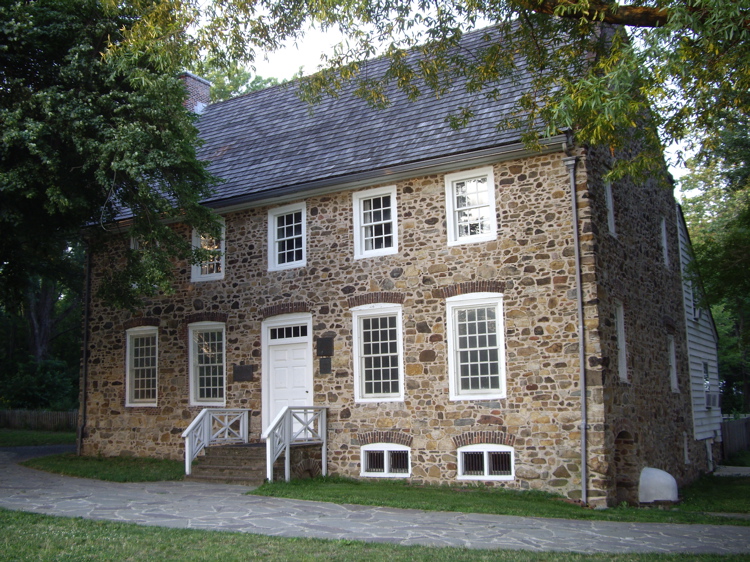
The conference was held on the south shore of Staten Island in a house owned by Colonel Christopher Billopp, a Loyalist. The Americans sent a delegation of three from Philadelphia: Edward Rutledge from South Carolina, the youngest signer of the Declaration of Independence; John Adams of Massachusetts; and elder statesman Benjamin Franklin.
The meeting lasted less than three hours and accomplished nothing. Howe was shocked that the three Americans rejected out of hand the idea of rejoining the mother country. More to the point, he had no authority to negotiate. For Adams and Rutledge, the diplomatic show must have seemed a waste of time. When Howe told Adams he thought of him as a "gentleman of influence," Adams retorted that Howe could "consider me in what light you please... except as a British subject."
The Billopp house, today known as the Conference House, is open April through mid-December on Fridays, Saturdays, and Sundays. More information about visiting can be found at http://www.theconferencehouse.org.
(More information on Henry Hudson and the Battle Brooklyn can be found in our forthcoming book, Inside the Apple.)
Subscribe to:
Posts (Atom)