GET UPDATES IN YOUR INBOX! Subscribe to our SPAM-free updates here:

GET UPDATES IN YOUR INBOX! Subscribe to our SPAM-free email here:

Delivered by FeedBurner

Showing posts with label Bowery. Show all posts

Thursday, January 11, 2018

Postcard Thursday: Skyrise for Harlem

Skyrise for Harlem; Esquire magazine, April 1965
There's a terrific exhibit at the Queens Museum called "Never Built New York," that features dozens of plans for unbuilt architecture that would have remade the city. (The show only runs through February 18, so catch it while you can.)

When we were visiting the show in October, we were struck by the plan from 1965 to tear down much of Harlem and replace it with giant, 100-story towers (seen above). James researched the subject further and his essay on "Skyrise for Harlem" appeared yesterday in Curbed NY. The story not only outlines the plan -- which architect Buckminster Fuller created with writer June Jordan -- but also looks at how Harlem real estate transformed during the late 19th and early 20th centuries.

You can read the story here: https://ny.curbed.com/2018/1/10/16868494/harlem-history-buckminster-fuller-development-rezoning.

From the ARCH/CAEHT plan for the East Harlem Triangle redevelopment; from the Louisiana State University archives

Fuller and Jordan weren't the only planners who were trying to figure out how to improve housing conditions in Harlem in the 1960s. The drawing above is from the Architects’ Renewal Committee in Harlem's suggested plan for the rezoning of the East Harlem Triangle. As James notes in his article:
In 1964, the Architects’ Renewal Committee in Harlem (ARCH) was founded to serve, in the words of architectural historian Brian D. Goldstein, as a “community design center” but then transformed—as the influence of black nationalism became more prominent in Harlem’s political life—into a way to “resist and revise official urban development plans".... Take, for example, the ARCH proposal for the East Harlem Triangle redevelopment.... The city’s plan was to turn the area—the triangle bounded by Madison Avenue, 125th Street, and the Harlem River—into an industrial zone. Pushback from the newly formed Community Association of the East Harlem Triangle (CAEHT) convinced the city to consider alternate proposals. Working with CAEHT, the planners at ARCH, led by its director, African-American architect J. Max Bond Jr., produced a plan that would not only radically transform the East Harlem Triangle, but would create a “distinctively black and democratic urban space.” 
As opposed to “Skyrise for Harlem,” the East Harlem Triangle plan advocated the preservation of newer townhouses and tenements, while new construction would preserve “positive features of the present living patterns".... On a reconfigured 125th Street, most of the traffic is eliminated in favor of wide sidewalks and tree-lined medians with bench seating. Typical examples from the urban planning wishlist are present, like a dedicated lane for bus traffic, while very specific symbols of Harlem abound: the bus boasts an ad for Muhammad Speaks, the newspaper of the Nation of Islam. A man in a dashiki stands in the median, while a woman on the sidewalk raises a black power salute.
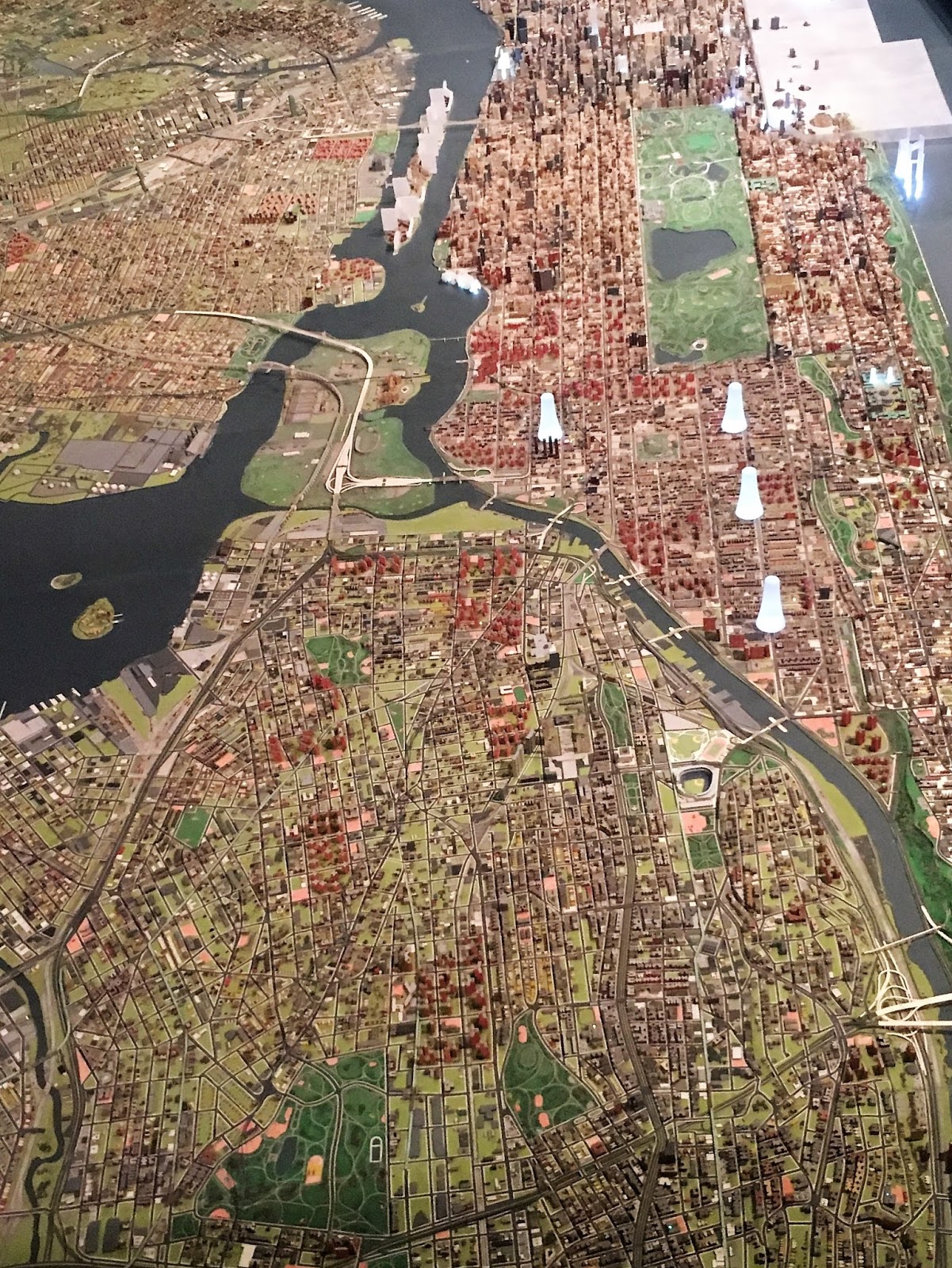
The Queens Museum panorama, with some of the Fuller/Jordan Skyrise towers superimposed over Harlem

* * *
Speaking of Curbed, three of James's pieces were singled out for the "Best of 2017" lists for both the local and national sites this year:

Monday, October 9, 2017

The History of the Bowery; The Fall of a Slumlord


In case you missed it, James had a wonderful story in Curbed this week tracing the history of New York's oldest street, The Bowery. Originally a deer path, the trail was used by subsequent generations of Native Americans and then widened by the Dutch settlers into a road to their farms, or bouwerij. The English corrupted the name to "Bowery" and the street became -- and remains -- a crucial thoroughfare in New York.

Read the entire story at https://ny.curbed.com/2017/10/4/16413696/bowery-nyc-history-lower-east-side.

* * *
Last week, notorious slumlord Steve Croman was sentenced to a year in jail for his shady dealings. James highlighted Croman in his exploration of Hans Haacke's conceptual artwork in a piece he wrote for Curbed back in 2015. You can read that interesting walk through the Lower East Side at https://www.curbed.com/2015/9/2/9924926/hans-haacke-photography-slumlord.


Thursday, June 15, 2017

Postcard Thursday: Last Chance for the Bowery


Reservations are going fast..... While the "early bird" deadline for signing up for our Sunday, June 25, tour of the Bowery is technically June 21, there are only a few spots left, so if you are planning to attend, do reserve at your earliest convenience. Full details below.

* * * * 

THE HISTORY OF THE BOWERY WALKING TOUR

Sunday, June 25 | 11am - 1pm

Join award-winning journalist, author, and guide James Nevius for a walk up New York City's oldest street.

From country road to immigrant entertainment district to Skid Row (and beyond), the Bowery has witnessed New York's rich history. Together, we will explore 400+ years of New York's story along this famous thoroughfare.

The tour is $20 per person for those who reserve before Tuesday, June 21 (when the price goes up to $25 per person).

To reserve, email walknyc@gmail.com with
  • Your name
  • The number in your party
  • And a cell phone where we can contact you the morning of the tour if there's any problems
Exact details of where to meet will be emailed to you within 24 hours of receiving your reservation.

Thursday, August 21, 2014

Postcard Thursday: The Third Avenue El


James is finishing up a piece right now on the history of St. Mark's Place in the East Village (we'll let you know when it's published), and as part of that research he's been reading about how the Second Avenue and Third Avenue Elevated trains were an integral part of the neighborhood for years.

This postcard, showing the Third Avenue El running along the Bowery, is ubiquitous in postcard shops (often the sort of card that can be picked up for under a dollar), which means they must have printed thousands of them at the turn of the twentieth century as a typical New York City view.

The Third Avenue El first opened in 1878, running from South Ferry to Grand Central. Two years later, a Second Avenue El began operating from a split at Chatham Square. The Third Avenue line eventually ran all the way into the Bronx (parts of its infrastructure are still used today by the 2 and the 5 trains), and was the last of the lines to come down in Manhattan, ceasing operation in 1955.

Do you have recollections of riding the Third Avenue El? If so, please let us know in the comments.

A crowd on St. Mark's Place watches the demolition of the Third Avenue El.
Photo by Calvin S. Hathaway, Dec. 16, 1955 (courtesy of the Museum of the City of New York)

Monday, February 9, 2009

What's in a Name?: The Bowery

Last week, Curbed and Racked pointed out that at least one new boutique on the ever-gentrifying Bowery would like to rename the entire neighborhood the “Bowery District.” This is just the most recent in a long line of attempts to change or repurpose the Bowery name over the years.

The original lane that now bears the name Bowery—the English corruption of the Dutch bouwerij or “farm”—led from the city of New Amsterdam into the countryside. The original lane now goes by three different names in its different sections: Park Row, the Bowery, and Fourth Avenue.

The most famous Dutch bouwerij was owned by Peter Stuyvesant, who lies buried in the churchyard of St. Mark’s in the Bowery on 10th Street and Second Avenue. For years, this church was known as St. 

Mark’s in the Bouwerie; its archaic spelling not only hearkened back to the days of the Dutch, but also helped distinguished it from the nearby thoroughfare. By the late 19th century, the Bowery had become synonymous with skid row.

A lot of the Bowery’s reputation was deserved, but at least part of the blame for its near-universal name recognition was the musical A Trip to Chinatown, which featured the song “The Bowery.” Its chorus boasts:

The Bow'ry, the Bow'ry
They say such things and they do strange things,
On the Bow'ry! The Bow'ry!
I'll never go there any more.

By 1916, the street’s reputation had gotten so bad that civic groups battled to come up with a new name for the thoroughfare. One suggestion was “Cooper Avenue” in honor of Cooper Union founder (and Jell-O pioneer)* Peter Cooper.

A rival proposition recommended “Central Broadway.” It’s hard to imagine the chaos this name change might have brought about in a city that already featured Broadway, West Broadway, and East Broadway.

Neither of these suggestions had any real traction, perhaps because there was still nostalgia for the old Bouwerie of Peter Stuyvesant. Indeed, that nostalgia was so strong that in 1956 a group of merchants suggested that Third Avenue be renamed “The Bouwerie,” to invoke the charm and refinement of a bygone age. (That this would have given the city a Bowery and a Bouwerie a block apart seems not to have figured into their calculations.) Plans were underway at the time to remove the last vestiges of the Third Avenue “El,” and it seemed logical to local boosters to get rid of the name Third Avenue—which they saw as intimately connected to the failure of the “El”—and replace it with Bouwerie, which would increase the street’s cachet and, presumably, retail rents.

(See our earlier post about York Avenue for another example of a street renaming in the same era for much the same reasons.)

* Peter Cooper and his gelatin fixation will be the subject of a future post.


You can read more about the Bowery in Inside the Apple; visit our home page www.insidetheapple.net.

* * *


* * *
To get RSS feeds from this blog, point your reader to this link. Or, to subscribe via email, follow this link.


* * *


Search This Blog

Blog Archive