GET UPDATES IN YOUR INBOX! Subscribe to our SPAM-free updates here:

GET UPDATES IN YOUR INBOX! Subscribe to our SPAM-free email here:

Delivered by FeedBurner

Friday, September 3, 2010

Happy Birthday, Louis Sullivan

Today, September 3, marks the birthday of renowned architect Louis Sullivan—the “father of modernism”—who would be 154 years old today. Sullivan was born in Boston, the son of an Irish immigrant father (who’d come to America in 1847, the worst year of the Irish Potato Famine) and a Swiss mother.

Sullivan is most closely associated with Chicago, where he moved in 1873, just two years after the Great Chicago Fire decimated the city—thus providing ample work for young architects. Indeed, Sullivan has only one building in New York, but it is superb: the Bayard-Condict Building at 65 Bleecker Street.

Originally just known as the Bayard Building, the skyscraper was commissioned in 1897 by the United Loan and Investment Company and named for one of New York’s oldest families.* However, by the time construction was underway, the bank had sold a controlling interest in the project to Silas Alden Condict who used the space for offices and light manufacturing. There is an oft-told story that Sullivan strenuously objected to the angels below the cornice. Supposedly, Condict insisted on the sextet of angels because he wanted “every tenant and every visitor to the Condict Building to realize the true spirit of fair dealing among men can and should prevail during the six business days of the week, as well as on the Sabbath.” However, as Robert C. Twombly and Narciso G. Menocal point out in Louis Sullivan: The Poetry of Architecture, similar motifs were already a part of Sullivan’s vernacular and the plans for the building were complete before Condict bought into the project, so it is unlikely that Sullivan objected to anything or that Condict had much say in the decorative scheme.

The building, which emphasizes its strong verticality with unbroken columns and is clad in brilliant cream terra cotta, made East Coast architectural critics take notice (perhaps because it was Sullivan’s first major work near their editorial offices). The Architectural Record wrote that it was “the nearest approach yet in New York… to solving the problem of the skyscraper.” The building was substantially renovated in 2000 and is well worth a detour the next time you are in the Village. (Or watching The Wizards of Waverly Place.)


* The Bayards owned a great deal of land in what is now Chinatown and the Village;
not only is there a Bayard Street in Chinatown, nearby Houston Street is
named for William Houstoun, who married Mary Bayard in 1788.


 * * *


Read more about early New York skyscrapers
in 
Inside the Apple: A Streetwise History of New York City.


To get RSS feeds from this blog, 
point your reader to this link.

To subscribe via email, 
follow this link.

Or 
follow us on Twitter.

Friday, August 20, 2010

Around the World in 16-1/2 Minutes

Ninety-nine years ago today, the New York Times decided to find out how long it would take a commercial telegram to circle the globe. The record had been set in 1903, when President Roosevelt celebrated the completion of the Commercial Pacific Cable by sending the first round-the-world message in just 9 minutes. However, that message had been given priority status and the Times wanted to see how long a regular message would take -- and what route it would follow.

At 7:00 p.m. on August 20, 1911, the
Times telegraph operator on the seventeenth floor of the newspaper's offices in Times Square sent a telegram that stated simply: "This message sent around the world." Sixteen-and-a-half minutes later, the same telegraph operator received his message back. In the intervening minutes the telegram had traveled from New York westward, stopping in:

  • San Francisco
  • Honolulu
  • Midway Island
  • Manila
  • Hong Kong
  • Saigon
  • Singapore
  • Madras
  • Bombay
  • Aden
  • Suez
  • Port Said
  • Alexandria
  • Malta
  • Gibraltar
  • Lisbon
  • The Azores
  • and then back to Times Square.
The Times was particularly struck by the portion of the route sent by the Indian Government telegraph from Madras to Bombay. "This line," they wrote, "traverses the domains of the Nizam of Hyderabad, the most powerful Prince in India, from the Coromandel to the Malabar coast, crossing the Indian peninsula and passing through great forests inhabited by man-eating tigers, panthers, boa constrictors, and pythons, and singing its way past the lonely residence of the American missionary, whose only gleam of civilization is the buzzing on the telegraph wires near his bungalow."

Today, the building where the
Times dispatched their record-setting message is called One Times Square and is best known for its news zipper and the dropping ball on New Year's Eve. The Times moved out in 1913 and eventually sold the building in 1961.


* * *


Read more about One Times Square and the history of the area
in 
Inside the Apple: A Streetwise History of New York City.


To get RSS feeds from this blog, 
point your reader to this link.

To subscribe via email, 
follow this link.

Or 
follow us on Twitter.

Tuesday, August 17, 2010

Robert Fulton and the Age of Steam


August 17, 1807 -- 203 years ago today -- was a pivotal moment in American history. Today marks the anniversary of the launch of Robert Fulton's North River* Steamboat. The boat left its slip in Lower Manhattan and steamed up the Hudson River, arriving in Albany fifty-two hours later. This maiden voyage proved that steam was an efficient and safe mode of transport and while clipper ships would not instantly disappear, the introduction of steam vessels forever changed maritime transportation.

Fulton started life as a painter, but his penchant for mechanical engineering led him to design the first practical submarine (which he tried, in vain, to sell to Napoleon) and then to turn his attention to steam navigation. In France, Fulton met Robert Livingston, the U.S. Minister and former Chancellor of New York State, who decided to bankroll Fulton in order to secure New York's preeminence as a commercial port. Fulton returned to the U.S., set up shop in Manhattan, and perfected his engine.

As we write in Inside the Apple:
On August 17, 1807, the boat, christened with the rather prosaic name North River Steamboat, left New York harbor en route to Albany. It arrived 52 hours later: 32 hours of that was steaming, and twenty hours was a diversion to Robert Livingston’s Hudson River estate, Clermont (where, presumably, the Chancellor took a long nap). The return trip, the next day, took just 30 hours and within a month twice-weekly service was scheduled between the two cities, averaging 36 hours per trip. (Hudson River sloops, by contrast, averaged a week for the same trip.) 
In her own day, the boat was only called by her own name, North River Steamboat, or simply “The Steamboat” (since she had no competition). It was only after Fulton’s death in 1815 that the name of Livingston’s estate, Clermont, became commonly associated with the vessel.
Chancellor Livingston was more than just Robert Fulton's patron -- he soon became his de facto father-in-law, when Fulton married Livingston's second cousin Harriet (who was the same age of the Chancellor's daughters). When Fulton died in 1815, he was buried in the churchyard of Trinity, Wall Street. However, he is not buried underneath the large marker in the south side of the yard that bears Fulton's portrait. That marker was erected by the Society of Mechanical Engineers in 1901 to stand in a high-traffic part of the graveyard and draw attention to their hero. Fulton is instead buried in the Livingston family's nondescript vault in the north side of the graveyard. If you happen to be downtown today, stop by Trinity and pay your respects to the man who in many ways secured New York's place as the economic capital of America.

* Until the 20th century, the Hudson River was
more commonly known as the North River.


* * *


Read more about Robert Fulton and the age of steam

To get RSS feeds from this blog, point your reader to this link.

To subscribe via email, follow this link.


Thursday, August 12, 2010

The Beginnings of the NYPD


On August 12, 1658 -- 352 years ago today -- New York's first municipal police force was founded. Of course, back in 1658 New York was still New Amsterdam and the police force went by another name -- the rattle watch.

The name derived from the wooden rattles that the patrol would carry. Eight men walked the streets of New Amsterdam from dusk to dawn; they would call out the hours all night long and, if they heard anything, shake their rattles to scare the person away. It was a system specifically designed to avoid confrontation. Membership in the rattle watch rotated amongst the
burghers of New Amsterdam and if you tried to shirk your duty, you'd be fined. (You would also be fined if you were caught sleeping on the job or if your uniform was deemed untidy.)

Despite the fact that the rattle watch was paid for by a tax levied on all citizens, it was disbanded briefly in 1660 due to lack of funds. The patrol was reorganized the next year and continued through the English Colonial period until evolving into a paid, professional police force.

In our research, we came across this groovy WPA era poster (above) that was part of a series commemorating the "History of Civic Services in the City of New York." Note that the date used on the poster for the establishment of the rattle watch is less accepted by historians today, but it's a great poster nonetheless and a reproduction can be purchased at Amazon.com for just $7.90.


* * *


Read more about Dutch Colonial New Amsterdam
in 
Inside the Apple: A Streetwise History of New York City.


To get RSS feeds from this blog, 
point your reader to this link.

To subscribe via email, 
follow this link.

Or 
follow us on Twitter.

Monday, August 9, 2010

The Assassination Attempt on Mayor William Jay Gaynor

Today marks the centennial of the assassination attempt on New York's mayor, William Jay Gaynor. We wrote about Gaynor and the attempt on his life back in November, on the 100th anniversary of his election. You can read about it here. (Note that the ship Gaynor was on at the time of his attack was the Kaiser Wilhem der Grosse, which just a few months earlier had been part of the spectacular Hoboken fire, which we blogged about back in June.)


* * *


Read more about famous New York City mayors in


To get RSS feeds from this blog, 
point your reader to this link.
Or, to subscribe via email, follow this link.
Also, you can now follow us on Twitter.

Wednesday, August 4, 2010

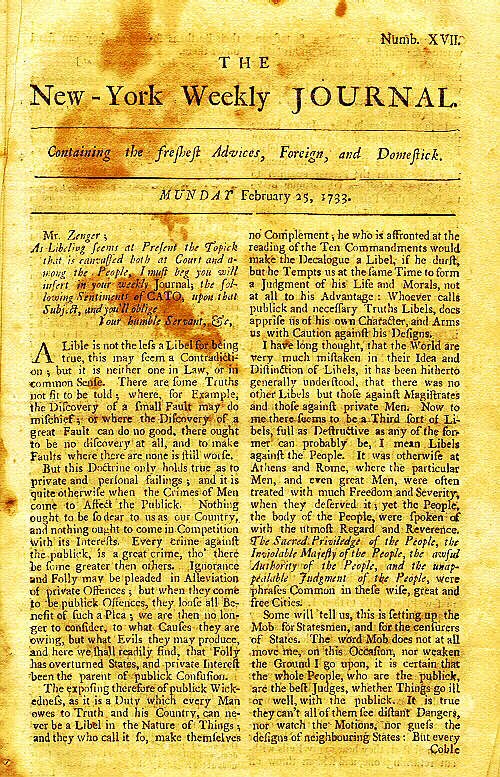
The Libel Trial of John Peter Zenger

Today marks the anniversary of one of the most important legal cases in American history—the trial of New York City printer John Peter Zenger. Two hundred and seventy-five years ago today, on August 4, 1735, Zenger stood trial for libeling New York’s colonial governor, William Cosby. Zenger’s lawyer, Andrew Hamilton—who’d been imported from Philadelphia to defend the printer—persuasively argued that truth was a defense against libel, making history.

Zenger came to America from Germany in 1710 and was apprenticed to New York City’s only newspaper publisher, William Bradford, who printed
The New York Gazette. After an eleven-year apprenticeship, Zenger struck out on his own, moving to Maryland. However, he had little luck there and ultimately moved back to New York where he eked out a living printing tracts and pamphlets.

In 1731, New York’s governor, John Montgomerie, died suddenly; a year later William Cosby arrived as his replacement and immediately stuck his nose into the thick of the city’s divisive political scene. Ticked off that Rip Van Dam, the interim governor, had been collecting a salary that Cosby deemed his own, Cosby sued. Two-thirds of the colony’s high court ruled in Cosby's favor; the Chief Justice, Lewis Morris,* voted against the governor and Cosby had him removed from the bench. Morris and his allies (who came to be known as the Popular Party or “Morrisites”) needed to find an outlet for their disdain for the governor. Since Bradford’s ­
Gazette was firmly controlled by the crown, they hired Zenger to produce the New York Weekly Journal as a mouthpiece for the Morrisites.

(As an example of the Gazette’s pro-Cosby editorializing, check out this couplet: “Cosby the mild, the happy, good and great/The strongest guard of our little state.”)

After a slew of increasingly bitter attacks on Cosby (most probably penned by Lewis Morris’s ally James Alexander), the governor decided to fight back. Because the articles were written anonymously—and because a publisher is ultimately responsible for the material he prints—it was Zenger who was arrested in November 1734 and charged with seditious libel. Throughout the winter of 1734-35, Zenger languished in jail while his wife, Anna, continued to print the
Journal. In order to strengthen his hand, Governor Cosby had Zenger’s lawyers disbarred and then tried to handpick the jurors for Zenger’s trial. (This latter tactic, at least, was rejected by the court.)

Finally, on August 4, Zenger was brought to trial. The prosecution presented their case to the jury and the new Chief Justice, James Delancey, and then Andrew Hamilton rose for the defense. After acknowledging that the case against Zenger was factually accurate—Zenger freely admitted to printing the attacks on Governor Cosby—Hamilton argued that precisely because it was fact it therefore couldn’t be libel. When Delancey and the prosecutors pointed out that truth didn’t come into play when considering seditious libel, Hamilton then turned to the jury to attempt to get them to nullify the law by voting not guilty. As Hamilton eloquently stated to the jury:
“Power may be justly compared to a great river which, while kept within its bounds is both beautiful and useful, but when it overflows its banks, is then too impetuous to be stemmed, it bears down on all before it and brings destruction and desolation wherever it goes.”
Despite Chief Justice Delancey’s instructions to the jury that, in essence, told them to ignore Hamilton, they agreed with Hamilton and found Zenger not guilty, thus establishing truth as a defense against libel, an argument that ultimately became part of the foundation of the First Amendment rights guaranteed in the Constitution.

Zenger died in 1746 (Anna continued to publish the
Journal after his death) and is reputedly buried in an unmarked grave in the churchyard at Trinity, Wall Street. His former boss, William Bradford, has a prominent grave marker in the same cemetery—and it has a typo. Bradford was born in 1663; his grave stone says 1660.

* Morris’s great-grandsons were active in the Revolutionary era: Gouverneur penned the Preamble to the Constitution and Lewis signed the Declaration of Independence.


* * *

Read more about Colonial New York inInside the Apple: A Streetwise History of New York City.

To get RSS feeds from this blog, 
point your reader to this link.

To subscribe via email, 
follow this link.

Or 
follow us on Twitter.

Monday, July 26, 2010

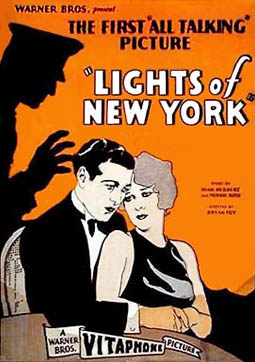
"Lights of New York" -- The First Real "Talkie"


On July 26, 1928 -- eighty-two years ago today -- the first all-talking film, Lights of New York, opened across the country, ushering in the era of sound film and effectively killing the silent movie.*

The film had actually opened in New York at the Strand Theater** on July 6th to lukewarm critical reaction (
The New York Times called it "crude in the extreme") but strong box office. Made for $23,000, the film ultimately grossed somewhere between $1.25 and $2 million dollars, thus proving that earlier sound films, like The Jazz Singer, weren't flukes. (Often billed as the first "talkie," The Jazz Singer has only two scenes of ad-libbed dialogue and the sound of Al Jolson singing; the rest of the film is essentially silent.)

The experimental nature of
Lights of New York is apparent in its staging: boom mics were not in use, so stationery microphones were hidden throughout the set. The blocking in the film suffers, since characters could only speak when near a microphone, causing odd breaks in the dialogue as people walk from one microphone to another.

 The film itself is a standard gangster movie: a rube from upstate comes to the city and ends up being the stooge for a Broadway speakeasy. However, the film had one notable line of dialogue: "Take him for a ride!" that went on to become a gangster cliche.


* By 1929, sound production was taking over and that year is
considered to be the last of the silent era though some directors -- notably
Charlie Chaplin -- would continue to make silent films well in the 1930s.


** The Strand is now gone; it stood on the site now occupied
by the Hershey's store at the northern end of Times Square.


* * *


Read more about New York in the 1920s in Inside the Apple: A Streetwise History of New York City.

To get RSS feeds from this blog, 
point your reader to this link.

To subscribe via email, 
follow this link.

Or 
follow us on Twitter.

Tuesday, July 13, 2010

The Civil War Draft Riots


Today marks the start of the Civil War Draft riots in 1863. Last year, we blogged extensively about each day of the riots. You can read about Day 1 here (or Day 2, 3, or 4).

We also, of course, cover the draft riots and their aftermath in Inside the Apple.

Monday, July 12, 2010

RIP Alexander Hamilton (1757-1804)


Two-hundred-and-six years ago today, at approximately two o'clock in the afternoon, Alexander Hamilton died in Greenwich Village, the victim of a bullet fired by Vice President Aaron Burr.


Hamilton, originally from Nevis in the British West Indies, had come to New York to study at King's College (today's Columbia University). He joined the Continental Army in 1776 and within a year was Washington's aide-de-camp, a role that in many ways he never relinquished. Part of a trio that formed Washington's first cabinet, Hamilton had disproportionate sway as Treasury Secretary--biographer Ron Chernow has called him Washington's de facto Prime Minister.


After leaving Washington's cabinet, Hamilton worked as an attorney in New York; founded the city's oldest paper, the New York Evening Post (as a mouthpiece for his Federalist agenda); and made life difficult for people like Aaron Burr. Burr served as Thomas Jefferson's first Vice President, but in 1804 he discovered he was being left off the ticket in favor of New York Governor George Clinton.


As we write in Inside the Apple:

[When this happened,] Burr chose to run for Governor [of New York] himself. When he lost, he blamed it, in part, on the conniving of people like Alexander Hamilton. While politicians often attacked each other in print, it was done using pseudonyms or by attacking the party rather than the person. However, at a dinner party in Albany in March 1804, Hamilton and other anti-Burr Federalists had a grand time describing why Burr was incapable of being “trusted with the reins of government.” One guest at the dinner, Dr. Charles Cooper, wrote a letter to a friend recounting the event; the letter was leaked, and before long Hamilton’s Evening Post was refuting its contents publicly. This caused Cooper to write a follow-up, published in the Albany Register, in which he declared that everything he’d said was true—and there was more. Had he wished to, Cooper could have recounted Hamilton’s “still more despicable opinion…of Mr. Burr.” It was these words—“despicable opinion,” which were not even Hamilton’s—that would eventually get him killed.


When Hamilton refused to apologize to Burr, the Vice President challenged him to a duel. Since New York City had sensibly banned dueling, they headed across the Hudson to Weehawken, New Jersey, on the morning of July 11, 1804. Much has been written about each man's intentions that morning, but the facts are these: Hamilton missed and Burr shot Hamilton straight through the stomach and liver. Hamilton was rushed back to New York and the next day, July 12, died, soon after his wife Eliza had reached him from their home in Harlem.

Hamilton is buried in the south yard at Trinity Church, Wall Street. If you work in that neighborhood or are visiting today, stop by and you'll see lots of coins on the grave--a memorial to America's first financial wizard.

 * * *


Read more about Hamilton, Burr, and Revolutionary New York in


To get RSS feeds from this blog, 
point your reader to this link.
Or, to subscribe via email, 
follow this link.

Also, you can now 
follow us on Twitter.


Friday, July 9, 2010

Should July 9th be Independence Day?

As we mentioned last week, the day we celebrate Independence Day in America, July 4th, isn't actually the day we voted to break away from Great Britain. While July 2 has a strong claim to be Independence Day, we'd also like to put forward today, July 9th, as a good candidate to celebrate America's birthday--at least in New York.

When the Continental Congress met in Philadelphia to vote on ratifying Thomas Jefferson's Declaration of Independence, the delegation from New York balked. This wasn't so much because New Yorkers weren't interested in backing independence, but rather that the colony's delegation (which included such notable citizens as Lewis Morris and Francis Lewis) didn't think that New York's legislature had given them the authority to take such a bold step.

Some time after July 2, the New York delegation left Philadelphia to return home to debate the matter and on July 9 voted to back the independence resolution, making them the thirteenth and final colony to get on board.

Later that same day, the first copies of the Declaration of Independence arrived in New York and, that evening, it was read aloud for the first time to George Washington's troops. In a frenzy, soldiers and members of the Sons of Liberty stormed down Broadway, jumped the fence at Bowling Green park, and toppled the gilded equestrian statue of of George III. (This is a story that we tell in depth in Inside the Apple.)


So, if you are around Lower Manhattan today, here's a couple of places to visit to honor what could have been Independence Day:

  • Bowling Green park, site of the George III statue and still surrounded by its British Colonial fence (erected ca. 1771).
  • Federal Hall National Memorial, on the spot where the New York delegation voted for Independence (and, later, where George Washington was inaugurated and the Bill of Rights passed).
  • Trinity Church, Wall Street, where Declaration of Independence signer Francis Lewis is buried in the north yard.


 * * *


Read more about the colonial and Revolutionary New York in


To get RSS feeds from this blog, 
point your reader to this link.
Or, to subscribe via email, 
follow this link.

Also, you can now 
follow us on Twitter.

Search This Blog

Blog Archive