GET UPDATES IN YOUR INBOX! Subscribe to our SPAM-free updates here:

GET UPDATES IN YOUR INBOX! Subscribe to our SPAM-free email here:

Delivered by FeedBurner

Showing posts with label Trinity Cemetery. Show all posts

Thursday, January 21, 2016

Postcard Thursday: Trinity Place


This rare view of Trinity Place shows the rear of Trinity Church, along with the Trinity Building (left) and the American Surety Building (right).

Trinity was built three times on the same spot. As we write in Inside the Apple:
In 1696...Trinity leased the city’s burial ground at the rate of one peppercorn per year. A year later, the church received its royal charter from William III and from that point forward only church members could be buried in the churchyard. Not coincidentally, this was the same time that a separate “Negroes Burial Ground” [today's African Burial Ground National Memorial] was established outside the city. The original church, a simple stone and wood building, was erected in 1698 with both financial and material help from one of its richest congregants, Captain William Kidd, who just three years later would be hanged in London for piracy. Trinity quickly prospered. Six years after its construction, Queen Anne gave the parish an additional 215 acres of the crown’s land, stretching from Wall Street north to the village of Greenwich....
The original Trinity had burned down on September 21, 1776, in the fire that swept through the city as Washington’s army retreated. A second church was consecrated in 1790, but a series of heavy snowstorms in the winter of 1838-39 so badly damaged the roof that the vestry voted to tear down the building and start again. The snows came at an opportune moment. Already, neighborhoods like Greenwich Village had pulled prominent churchgoers northward.... Trinity needed to do something to return itself—in its own eyes, at least—to its rightful place as the city’s premiere religious institution. 
Richard Upjohn’s grand Gothic Revival building quickly restored Trinity to the forefront of the city’s social and architectural scene. In 1844, architect Albert Gilman wrote of the almost-finished church: “[It] surpasses any church erected in England since the revival of the pointed style.” Its spire, at 281 feet tall, made it not only the tallest church in the city, but New York’s tallest building, a title it would retain for nearly 50 years. Part of what made the church so perfect was that Upjohn had copied it, almost exactly, from the design for “An Ideal Church” in the book True Principals by A.W. Pugin, the leading English proponent of the Gothic Revival. And unlike many of Upjohn’s successors and imitators, he had an attention to detail—overseeing everything from the stained glass to the exterior carvings—that gave Trinity an unequalled aesthetic appeal. 
The building was also controversial, however, both inside and out. A devout “high church” Anglo-Catholic, Upjohn introduced architectural elements that were utterly foreign to most Americans, including a chancel at the west end of the church complete with a high altar and rows of choir stalls. (At first, this was deemed too Roman Catholic, and the stalls weren’t used.) Outside, the building was constructed of brownstone, a locally quarried, soft sandstone. The stone was chosen for its outward resemblance to materials used in medieval English architecture, but not only did it lack the strength of schist, it was also commonly considered a cheap building material. Though many people tend today to call all single-family townhouses in New York “brownstones,” in the 19th-century no one would have conflated cheaper brownstone buildings with their more expensive brick cousins. (In her autobiography, Edith Wharton deplored the look of New York, claiming it was bathed in a “universal chocolate-coloured coating of the most hideous stone ever quarried.”) Both at Trinity and at Ascension in Greenwich Village, Upjohn had to convince his employers that the look of brownstone outweighed its déclassé associations.


By illustrating the church from the Trinity Place side, the postcard also includes in the foreground the elevated railroad. Depicted in the postcard is the Rector Street station of the Sixth Avenue El; the line ran up Trinity Place, then connected to West Broadway, and ultimately jogged over to Sixth Avenue at West 3rd Street. (James wrote about this briefly in his West Broadway article last week.)

For a better look at the station, check out this image: https://picasaweb.google.com/116363262722377355677/NYC6thAveEl#5321244791228262242


* * * *
Read more about NYC history in

Tuesday, June 4, 2013

Don't Give Up the Ship!


Today, June 4, is the two-hundredth anniversary of the death of James "Don't Give Up the Ship!" Lawrence, the commander of the USS Chesapeake in the War of 1812. Even if you've never heard of Lawrence, his dying command has filtered down to us as a great American saying. Lawrence is prominently buried at Trinity Church, Wall Street, near the southern entrance to the churchyard.

Lawrence, born in New Jersey, joined the fledgling United States Navy in 1798, just in time for our two-year, undeclared war with France. He rose through the ranks quickly and in 1810 was put in command of the USS Hornet. When war broke out with Great Britain in 1812, the Hornet was used as blockade runner and helped squelch British privateering. In 1813, Lawrence was given command of the Chesapeake; on June 1, they left Boston and immediately ran afoul of a British blockade and the HMS Shannon. This was no surprise--the Shannon's captain, Philip Bowes Vere Broke, had personally challenged Lawrence to a fight.

The Chesapeake was quickly overwhelmed; in the first fifteen minutes of fighting over 200 people were killed, and Lawrence lay fatally wounded. He ordered his men fight until the ship sank. "Don't give up the ship!" he exhorted. The wounded Chesapeake was no match for the British, however, and the Americans were soon captured and taken to Nova Scotia, where Lawrence died of his wounds three days later as his captured vessel was being towed to Halifax.

After Commander Oliver Perry heard of his friend Lawrence's bravery, he had a battle ensign sewn with the words "Don't Give Up the Ship" emblazoned across it. Perry flew the flag during the Battle of Lake Erie, a major American victory. Perry's ensign now hangs at the Naval Academy Museum.

Lawrence was buried in Halifax, then transferred to Massachusetts, and ultimately sent to Trinity. Lawrence's original marble grave marker now resides in the collection of the New-York Historical Society; the current, monumental grave marker, was erected after the Civil War.

* * * *
Read more about New York's role in the War of 1812 in

To get RSS feeds from this blog, point your reader to this link.
Find us on Facebook.
To subscribe via email, follow this link.

Tuesday, August 17, 2010

Robert Fulton and the Age of Steam


August 17, 1807 -- 203 years ago today -- was a pivotal moment in American history. Today marks the anniversary of the launch of Robert Fulton's North River* Steamboat. The boat left its slip in Lower Manhattan and steamed up the Hudson River, arriving in Albany fifty-two hours later. This maiden voyage proved that steam was an efficient and safe mode of transport and while clipper ships would not instantly disappear, the introduction of steam vessels forever changed maritime transportation.

Fulton started life as a painter, but his penchant for mechanical engineering led him to design the first practical submarine (which he tried, in vain, to sell to Napoleon) and then to turn his attention to steam navigation. In France, Fulton met Robert Livingston, the U.S. Minister and former Chancellor of New York State, who decided to bankroll Fulton in order to secure New York's preeminence as a commercial port. Fulton returned to the U.S., set up shop in Manhattan, and perfected his engine.

As we write in Inside the Apple:
On August 17, 1807, the boat, christened with the rather prosaic name North River Steamboat, left New York harbor en route to Albany. It arrived 52 hours later: 32 hours of that was steaming, and twenty hours was a diversion to Robert Livingston’s Hudson River estate, Clermont (where, presumably, the Chancellor took a long nap). The return trip, the next day, took just 30 hours and within a month twice-weekly service was scheduled between the two cities, averaging 36 hours per trip. (Hudson River sloops, by contrast, averaged a week for the same trip.) 
In her own day, the boat was only called by her own name, North River Steamboat, or simply “The Steamboat” (since she had no competition). It was only after Fulton’s death in 1815 that the name of Livingston’s estate, Clermont, became commonly associated with the vessel.
Chancellor Livingston was more than just Robert Fulton's patron -- he soon became his de facto father-in-law, when Fulton married Livingston's second cousin Harriet (who was the same age of the Chancellor's daughters). When Fulton died in 1815, he was buried in the churchyard of Trinity, Wall Street. However, he is not buried underneath the large marker in the south side of the yard that bears Fulton's portrait. That marker was erected by the Society of Mechanical Engineers in 1901 to stand in a high-traffic part of the graveyard and draw attention to their hero. Fulton is instead buried in the Livingston family's nondescript vault in the north side of the graveyard. If you happen to be downtown today, stop by Trinity and pay your respects to the man who in many ways secured New York's place as the economic capital of America.

* Until the 20th century, the Hudson River was
more commonly known as the North River.


* * *


Read more about Robert Fulton and the age of steam

To get RSS feeds from this blog, point your reader to this link.

To subscribe via email, follow this link.


Wednesday, August 4, 2010

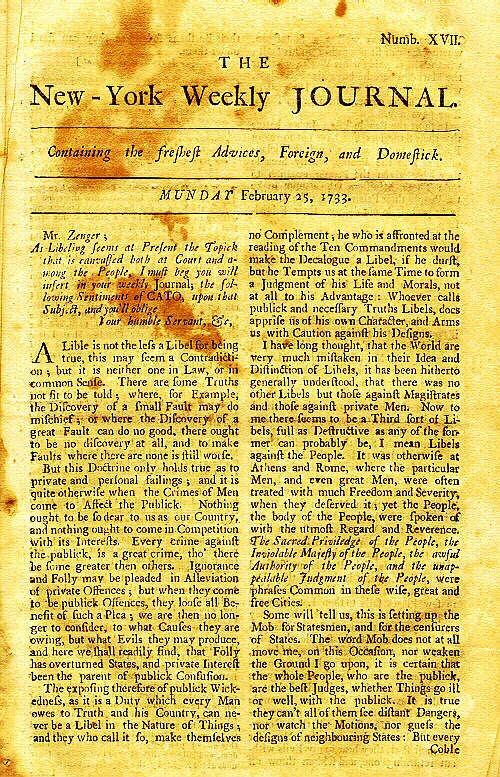
The Libel Trial of John Peter Zenger

Today marks the anniversary of one of the most important legal cases in American history—the trial of New York City printer John Peter Zenger. Two hundred and seventy-five years ago today, on August 4, 1735, Zenger stood trial for libeling New York’s colonial governor, William Cosby. Zenger’s lawyer, Andrew Hamilton—who’d been imported from Philadelphia to defend the printer—persuasively argued that truth was a defense against libel, making history.

Zenger came to America from Germany in 1710 and was apprenticed to New York City’s only newspaper publisher, William Bradford, who printed
The New York Gazette. After an eleven-year apprenticeship, Zenger struck out on his own, moving to Maryland. However, he had little luck there and ultimately moved back to New York where he eked out a living printing tracts and pamphlets.

In 1731, New York’s governor, John Montgomerie, died suddenly; a year later William Cosby arrived as his replacement and immediately stuck his nose into the thick of the city’s divisive political scene. Ticked off that Rip Van Dam, the interim governor, had been collecting a salary that Cosby deemed his own, Cosby sued. Two-thirds of the colony’s high court ruled in Cosby's favor; the Chief Justice, Lewis Morris,* voted against the governor and Cosby had him removed from the bench. Morris and his allies (who came to be known as the Popular Party or “Morrisites”) needed to find an outlet for their disdain for the governor. Since Bradford’s ­
Gazette was firmly controlled by the crown, they hired Zenger to produce the New York Weekly Journal as a mouthpiece for the Morrisites.

(As an example of the Gazette’s pro-Cosby editorializing, check out this couplet: “Cosby the mild, the happy, good and great/The strongest guard of our little state.”)

After a slew of increasingly bitter attacks on Cosby (most probably penned by Lewis Morris’s ally James Alexander), the governor decided to fight back. Because the articles were written anonymously—and because a publisher is ultimately responsible for the material he prints—it was Zenger who was arrested in November 1734 and charged with seditious libel. Throughout the winter of 1734-35, Zenger languished in jail while his wife, Anna, continued to print the
Journal. In order to strengthen his hand, Governor Cosby had Zenger’s lawyers disbarred and then tried to handpick the jurors for Zenger’s trial. (This latter tactic, at least, was rejected by the court.)

Finally, on August 4, Zenger was brought to trial. The prosecution presented their case to the jury and the new Chief Justice, James Delancey, and then Andrew Hamilton rose for the defense. After acknowledging that the case against Zenger was factually accurate—Zenger freely admitted to printing the attacks on Governor Cosby—Hamilton argued that precisely because it was fact it therefore couldn’t be libel. When Delancey and the prosecutors pointed out that truth didn’t come into play when considering seditious libel, Hamilton then turned to the jury to attempt to get them to nullify the law by voting not guilty. As Hamilton eloquently stated to the jury:
“Power may be justly compared to a great river which, while kept within its bounds is both beautiful and useful, but when it overflows its banks, is then too impetuous to be stemmed, it bears down on all before it and brings destruction and desolation wherever it goes.”
Despite Chief Justice Delancey’s instructions to the jury that, in essence, told them to ignore Hamilton, they agreed with Hamilton and found Zenger not guilty, thus establishing truth as a defense against libel, an argument that ultimately became part of the foundation of the First Amendment rights guaranteed in the Constitution.

Zenger died in 1746 (Anna continued to publish the
Journal after his death) and is reputedly buried in an unmarked grave in the churchyard at Trinity, Wall Street. His former boss, William Bradford, has a prominent grave marker in the same cemetery—and it has a typo. Bradford was born in 1663; his grave stone says 1660.

* Morris’s great-grandsons were active in the Revolutionary era: Gouverneur penned the Preamble to the Constitution and Lewis signed the Declaration of Independence.


* * *

Read more about Colonial New York inInside the Apple: A Streetwise History of New York City.

To get RSS feeds from this blog, 
point your reader to this link.

To subscribe via email, 
follow this link.

Or 
follow us on Twitter.

Friday, July 9, 2010

Should July 9th be Independence Day?

As we mentioned last week, the day we celebrate Independence Day in America, July 4th, isn't actually the day we voted to break away from Great Britain. While July 2 has a strong claim to be Independence Day, we'd also like to put forward today, July 9th, as a good candidate to celebrate America's birthday--at least in New York.

When the Continental Congress met in Philadelphia to vote on ratifying Thomas Jefferson's Declaration of Independence, the delegation from New York balked. This wasn't so much because New Yorkers weren't interested in backing independence, but rather that the colony's delegation (which included such notable citizens as Lewis Morris and Francis Lewis) didn't think that New York's legislature had given them the authority to take such a bold step.

Some time after July 2, the New York delegation left Philadelphia to return home to debate the matter and on July 9 voted to back the independence resolution, making them the thirteenth and final colony to get on board.

Later that same day, the first copies of the Declaration of Independence arrived in New York and, that evening, it was read aloud for the first time to George Washington's troops. In a frenzy, soldiers and members of the Sons of Liberty stormed down Broadway, jumped the fence at Bowling Green park, and toppled the gilded equestrian statue of of George III. (This is a story that we tell in depth in Inside the Apple.)


So, if you are around Lower Manhattan today, here's a couple of places to visit to honor what could have been Independence Day:

  • Bowling Green park, site of the George III statue and still surrounded by its British Colonial fence (erected ca. 1771).
  • Federal Hall National Memorial, on the spot where the New York delegation voted for Independence (and, later, where George Washington was inaugurated and the Bill of Rights passed).
  • Trinity Church, Wall Street, where Declaration of Independence signer Francis Lewis is buried in the north yard.


 * * *


Read more about the colonial and Revolutionary New York in


To get RSS feeds from this blog, 
point your reader to this link.
Or, to subscribe via email, 
follow this link.

Also, you can now 
follow us on Twitter.

Friday, January 29, 2010

J.D. Salinger's Early Life on the West Side

J.D. Salinger on the cover of Time, 1961


Yesterday brought the sad news of the death of J.D. Salinger, author of the classic New York tale Catcher in the Rye.
The New York Times obit mentioned briefly that Salinger had been born in Harlem, so we decided to do a little digging and found that he'd been born just south of Trinity Cemetery at 3681 Broadway (at 153rd Street). The building, Halidon Court, was built in 1910 and designed by Emery Roth, who would later go on to build such famous Upper West Side edifices as the Eldorado and the Beresford -- and another of Salinger's future homes. This handsome building still stands.
The Salinger family moved within a year of J.D.'s birth to an apartment on the Upper West Side at 113th Street and Riverside Drive. According to biographer Paul Alexander, "between 1919 and 1928, the Salingers moved three more times before they ended up in a pleasant apartment on West Eighty-second Street."

That "pleasant" apartment was at the Myron Arms at 221 West 82nd Street, then a relatively new building, which had also been designed by Emery Roth. Though Salinger moved out of the neighborhood for the Upper East Side, Salinger later attended the McBurney School on West 64th Street for two years before flunking out. The McBurney School appears in Catcher in the Rye; it's the school to which the fencing team is heading when Holden leaves the foils on the subway. (The school later moved from West 64th Street and that original building no longer stands.)

The Myron Arms is still there, however -- just across the street from Barnes & Noble -- so if you're heading in that direction to replace your dog-eared copy of
Catcher in the Rye or Nine Stories
, take a moment to admire Salinger's boyhood home. 


* * *


Read more about the Upper West Side -- and take a self-guided walking tour -- inInside the Apple: A Streetwise History of New York City.
To get RSS feeds from this blog, point your reader to this link.
Or, to subscribe via email, follow this link.
Also, you can now follow us on Twitter.

Search This Blog

Blog Archive