GET UPDATES IN YOUR INBOX! Subscribe to our SPAM-free updates here:

GET UPDATES IN YOUR INBOX! Subscribe to our SPAM-free email here:

Delivered by FeedBurner

Showing posts with label Brevoort Hotel. Show all posts

Tuesday, May 19, 2009

Charles Lindbergh and the Orteig Prize


Eighty-two years ago today, in the early morning hours of May 20, 1927, aviator Charles Lindbergh took off from Roosevelt Field in Garden City, Long Island, and headed east. Thirty-three and a half hours later, he touched down at Le Bourget airport in Paris, making Lindbergh the first aviator to successfully fly nonstop from New York to Paris and the winner of the $25,000 Orteig Prize.

The Orteig Prize was sponsored by hotelier Raymond Orteig who owned the Lafayette and Brevoort Hotels in Manhattan. Orteig, hoping to boost Franco-American relations, first offered the prize to complete a transatlantic flight in 1919. When no one had made an attempt in five years, Orteig extended the competition and by 1926 it had begun drawing serious competitors. However, the hazards of aviation meant that by the time Lindbergh began his historic flight, six of his fellow competitors had died.

Lindbergh's flight in the Spirit of St. Louis began on May 20 at 7:52 a.m. with his ground crew pushing the heavy plane down the muddy runway. The plane carried 450 gallons of fuel but Lindbergh had removed as much as possible from the plane, including his sextant--meaning that Lindbergh would have to fly by the stars (if they were visible) or dead reckoning. Lindbergh dodged bad weather across the Atlantic (sometimes flying as low as twelve feet above the waves) and reached Le Bourget at 10:22 p.m. on May 21st where he was mobbed by a crowd of eager well-wishers.

Upon his return (by steamship) to America, Lindbergh was feted in Washington, D.C., before heading to New York. On June 13th, the aviator was honored with a tickertape parade on Lower Broadway. Three days later, he collected the Orteig Prize at a breakfast at the Breevort Hotel with Orville Wright in attendance. (The Breevort Hotel was demolished in 1953 to be replaced by the Brevoort apartments.)

The successful flight spurred tremendous interest in aviation and Lindbergh became America's most visible spokesman for commerical flight.

* * *
Much more about New York in the Roaring Twenties can be found in Inside the Apple: A Streetwise History of New York City, available now.

To get RSS feeds from this blog, point your reader to this link.
Or, to subscribe via email, follow this link.

Also, you can now follow us on Twitter.

Tuesday, February 3, 2009

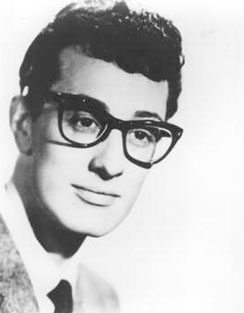
Buddy Holly in Greenwich Village: The Brevoort

I can’t remember if I cried

When I read about his widowed bride

But something touched me deep inside

The day the music died.

—Don McLean, American Pie


Today, February 3, 2009, marks the 50th anniversary of the “day the music died”—the plane crash in Clear Lake, Iowa, that claimed the lives of Ritchie Valens, the Big Bopper, and rock and roll pioneer Buddy Holly.

Originally from Lubbock, Texas, Holly was one of the earliest stars to take what was then still being called “race music” and cross over to white audiences. His early hits with the Crickets—including That’ll Be The Day, Peggy Sue, Oh Boy!, and Not Fade Away—had a profound influence on later acts (including the Beatles and Bob Dylan, who were huge fans) and are still some of the greatest rock songs ever written.

Before his untimely death at age 22, Holly had split with the Crickets and moved to New York City to be closer to the New York music scene. He and his new bride, Maria Elena, moved into the Brevoort apartments at 11 Fifth Avenue. What was then a brand-new apartment building had recently replaced the famous Brevoort Hotel, which had at one time been among the city’s finest hostelries. (Among other famous events, the Brevoort Hotel was the place where Charles Lindbergh received the $25,000 Orteig Prize for his solo flight across the Atlantic; Orteig was the hotel’s owner.)

From print and online sources, it seems unclear if Buddy Holly lived in Apartment 4H or Apartment 3B. (Holly fans--feel free to chime in below in the comments section.) Whichever apartment it was, he set up a home tape recorder and in December 1958 made his final recordings, among them Crying, Waiting, Hoping and Peggy Sue Got Married. Posthumously released with overdubs and studio trickery, the original tapes have circulated for decades among collectors. They were recently included on the definitive Holly rarities set, Down the Line.

When Holly moved in to the Brevoort in 1958, he paid $1,000 a month rent for a corner unit with a wraparound terrace. A two-bedroom apartment in the building (which has been a co-op since 1981) now goes for about $1.495 million.

* * * 

If you are interested in doing a Rock and Roll tour of the city that includes the Brevoort—and many more famous rock and roll sites—we wrote the script for a tour of famous music spots in the East and West Village. The tour, narrated by DJ Ken Dashow, is available for download at www.citylisten.com.


You can also read about New York in the 1960s in Inside the Apple, available for pre-order today.

* * *


* * *
To get RSS feeds from this blog, point your reader to this link. Or, to subscribe via email, follow this link.


* * *

Search This Blog

Blog Archive