GET UPDATES IN YOUR INBOX! Subscribe to our SPAM-free updates here:

GET UPDATES IN YOUR INBOX! Subscribe to our SPAM-free email here:

Delivered by FeedBurner

Thursday, January 23, 2014

Postcard Thursday: Grant's Tomb


This great shot of Grant's Tomb is from sometime in the early twentieth century, and if you've toured with us, you may have seen this on our walk of Morningside Heights. (This scene has to be after 1907 due to the type of postcard, but we aren't car buffs -- can someone identify any makes or models?) As you can see in this picture, Riverside Park and Grant's Tomb were popular destinations for Sunday drives.

From its opening in 1897, Grant's Tomb became a magnet for tourists and New Yorkers alike who were coming not just to honor the memory of the great Civil War hero, but also to gawk at the country's largest presidential tomb. As we write in Inside the Apple:
Grant died in 1885, having lived the last four years of his life in New York. His tomb sits at 122nd Street and Riverside Drive, at one of the highest points in Riverside Park....[It is] a remarkable testament to the high esteem in which Grant was held after his death (despite two terms as president marked by scandal and perceived mediocrity) as well as to New York’s growing obsession in the 1890s with becoming the premiere American city. First, New York beat out other places Grant had lived—including Galena, Illinois, and St. Louis, Missouri—for the right to bury the president. Then, the Grant Memorial Association held two contests to determine who would design the structure, the second contest being held because none of the entries the first time around was deemed grand enough. The tomb, by John Duncan, is modeled on the mausoleum at Halicanarssus, one of the Seven Wonders of the Ancient World. In 1897, the tomb was officially opened and it fast became the leading tourist attraction in the city. Indeed, more people visited Grant’s Tomb in the early years of the Twentieth Century than went to the Statue of Liberty.
In the meantime, if you want to find out the answer to the old riddle, "Who's buried in Grant's Tomb?" you'll simply have to go check it out in person. The tomb is run by the National Park Service and is open for visitation.

* * * *
Read more about Grant's Tomb and Riverside Park in


and don't forget our next book


Footprints in New York comes out April 15, 2014, but you can pre-order today.

Thursday, January 16, 2014

Postcard Thursday: The Skyscrapers of New York


This 1908 postcard shows New York's early love affair with the skyscraper--and the the ongoing quest by developers to construct the tallest building in the world.

The tower on the left is the Park Row building, finished in 1899. Designed by R.H. Robertson, it held the title of world's tallest until the opening of the nearby Singer tower (center) in 1907.

This image doesn't do the Singer Building justice--we'll include some great images of it in a future Postcard Thursday. It was a singular building, designed by Ernest Flagg, and featured the same green-and-red color scheme as Flagg's earlier work for the sewing machine company in Soho.

If the Singer company had hoped that having the world's tallest building as their headquarters would be a good marketing tool, it didn't last long. However, it did last longer than this postcard implies. When this card was printed in 1908, the tower on the right, Metropolitan Life, wasn't actually finished. That tower opened in 1909 and was the world's tallest until the Woolworth Building was completed in 1913.

The Singer Building has a sad claim to fame--it's the tallest of all the buildings to claim the title of "World's Tallest" to have been torn down for another skyscraper. It came down in the late 1960s so that One Liberty Plaza could go up in its place. Though New York had already passed its landmarking laws, the Singer Tower had not yet been designated worthy of preservation and so fell to the wrecking ball.

However, the other buildings on this card are there to see: the Park Row Building houses J&R on Park Row and the Metropolitan Life Building on Madison Square is being converted into a hotel, which will open in 2015.


* * * *
Read more about the World's Tallest Building in


and don't forget our next book


Footprints in New York comes out April 15, 2014, but you can pre-order today.

Friday, January 10, 2014

Happy Birthday, Howard Chandler Christy


On January 10, 1873, artist and illustrator Howard Chandler Christy was born in Ohio. While not a household name today, in the early twentieth century, Christy was one of New York's premiere artists.

With $300 in his pocket, Christy came to New York in 1890 to pursue a career as an artist. He enrolled at the Art Students League, where he studied under William Merritt Chase, both at the school and at Chase's home at the famed Tenth Street Studio in Greenwich Village.


Christy was soon earning his keep as a commercial illustrator, and when the brief Spanish-Ameican War broke out in 1898, he traveled to Cuba to cover the events for the New York papers. This somewhat pigeon-holed Christy as a "war" illustrator, which made him much in demand for recruitment and propaganda illustrations during World War I.


For many years, Christy lived at Hotel des Artistes, the Upper West Side residence designed for artists that was built following the success of the Tenth Street Studio and other artists' enclaves. Most of the studios in the hotel did not have kitchens, and artists were expected to dine together in the building's ground-floor restaurant. If the stories are true, Christy in the 1930s found himself in financial straits and unable to pay his restaurant tab. Instead, he bartered his services to decorate the Cafe des Artistes with thirty-six murals of scantily-clad nymphs. Those paintings, recently restored, are still on view at Cafe des Artistes's successor, The Leopard.


In his later years, Christy received his most important commission, a painting depicting the signing of the Constitution, which was installed in the House of Representatives in 1940. Christy died at Hotel des Artistes in 1952.


* * * *
Read more about New York and the Tenth Street Studio in


and don't forget our next book

Footprints in New York comes out April 15, 2014, but you can pre-order today.

Friday, January 3, 2014

A Look Back at the History of Gracie Mansion

Gracie Mansion today (photo by Carol M. Highsmith; courtesy of the Library of Congress)

James has a piece running today at Curbed, the #1 website for real estate and architectural history in New York. The story, "How Gracie Mansion Became New York's 'Little White House'" looks at Robert Moses and his quest to find an appropriate official mayoral residence for Fiorello La Guardia.

Take a look over at Curbed and let us know what you think:
http://ny.curbed.com/archives/2014/01/03/how_gracie_mansion_became_new_yorks_little_white_house.php

* * * *
Robert Moses's effect on NYC is covered more in 


and our forthcoming book


Robert Moses and his epic battles with Jane Jacobs are a chapter in
Footprints in New York; the book is out April 15, 2014, but you can pre-order today.


Thursday, January 2, 2014

Postcard Thursday: Central Park Gondola


Last week, when the weather was nicer, we posted a winter scene in Central Park; today, on the eve of a blizzard, here's the park in sunnier weather.

This view--more often seen in black and white than in color--shows the Central Park gondolier plying his trade on a crowded day in the late nineteenth century. (Look at how many people are standing on Bethesda Terrace.)

Central Park's original gondola was a gift of John A.C. Gray, a Central Park commissioner, in 1862. There's some confusion as to when it was first used: In 1864, a book of photographs and descriptions of the park by Fred B. Perkins and W.H. Guild, Jr., showed the gondola on the lake. However, five years later, in The Description of the New York Central Park, the first guidebook to the park, the author lamented that the gondola "is not used, because Mr. Gray did not...present the Commissioners with a Venetian gondolier to manage it!"


photo by WH Guild, Jr., from The Central Park (1864)

Certainly by the 1890s, gondola rides were a park attraction, especially at night, when visitors could be poled around the lake to look at the night sky.

Gray's original 1862 donation continued to be used in the park until the 1980s, when it was finally replaced by another authentically Venetian original. Today, gondola rides can be arranged at the Loeb boathouse.

* * * *


Read more about the life of Central Park in Inside the Apple

or in our new book:


The birth of Central Park is a chapter in Footprints in New York; the book is out April 15, 2014, but you can pre-order today.

Tuesday, December 31, 2013

The Times Square Ball Drop


Tonight, an estimated billion people around the world will watch the illuminated ball drop in Times Square to ring in the new year. This New Year’s tradition dates back 106 years—the dropping ball replaced an earlier fireworks display—but the notion of dropping a ball as a way of keeping time is an older tradition.

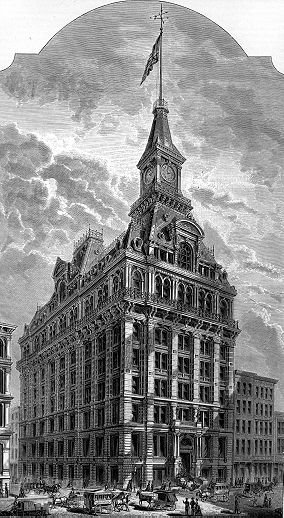
In 1877, a ball was added to the top of the Western Union Building on Lower Broadway. Each day at noon, a telegraph signal from Western Union’s main office in Washington, DC, would trip a switch in New York and the ball would descend from the flagpole. Visible throughout the Financial District—and, more importantly, from all the ships in the harbor—it allowed people to reset their watches and ship chronometers. For the first time, New York ran on a standard time.

As the New York Times noted in 1877, this idea of a ball dropping to keep the time wasn’t new. For many years prior to the Civil War, the New York custom house had signaled the time with a ball drop and in the 1870s it was common to find time balls in major European ports. However, when it began operation in April 1877, the Western Union ball was the only one in a North American port and quickly became a fixture of the Manhattan skyline.

(Western Union, afraid that it wasn’t always going to work, set up a system whereby a red flag would be flown from 12:01 to 12:10 p.m. on days that the ball refused to drop. Further, information would be sent to the press each day informing them whether the ball actually dropped at noon or had fallen at the wrong time!)

In 1907, the New York Times—then owners of the skyscraper from which the ball drops on New Year’s Eve—adopted the time ball as their symbol for ushering in the new year. That original Times Square ball, made of iron and wood and lit by 25 incandescent lights, weighed 700 pounds!

In 1911, the original Western Union Building was demolished by the company’s new owners, AT&T, so they could erect a larger structure. (That impressive marble building, known as 195 Broadway, still stands.) Plans called for a new time ball, but by the time the new AT&T headquarters was finished, the ball had been replaced by a giant, gilded statue by Evelyn Beatrice Longman called The Genius of Electricity. (The statue remained on the building until 1980, when it was removed, restored, and installed in lobby of the AT&T headquarters in Midtown. It now resides in Dallas, Texas.)

The current time ball, lit by energy-efficient LED diodes, now stays atop the old Times Building year round so that everyone who visits New York can see the actual ball that drops on New Year’s Eve.

[This article was adopted from an earlier post from 2009.]

Thursday, December 26, 2013

Postcard Thursday: Winter Scene Central Park

Welcome to our new feature, "Postcard Thursday," in which we dive into our extensive archive of New York City scenes to find some gems.

This unusual shot just came into our possession recently. There's no publication date or copyright on the card, but it has to be from 1907 or earlier. Prior to that year, messages had to be only on the front side of card (that's what the little white space at the bottom is for); the back was reserved entirely for the recipient's address.

Early Central Park views have a tendency to be spring and summer images, focusing on the Mall, Bethesda Terrace, Bow Bridge (then known as Swan Bridge) and a few other architectural features. Winter views are less common, even though more people came to park in winter than in summer during its first years in operation. What drew many winter revelers were the Lake and Pond--both used for ice skating--and the carriage drive, which could used for sleighing.

The view in this card is Gapstow Bridge, which crosses the Pond in the southeast corner of the park. When this image was created, the pond was bigger--it used to go all the way to the area occupied by Wollman Rink.


* * * *


Read more about the life of Central Park in Inside the Apple

or in our new book:


The birth of Central Park is a chapter in Footprints in New York; the book is out April 15, 2014, but you can pre-order today.


Thursday, December 19, 2013

Gilded New York

Gilded New York • © Julie Saad Photography; courtesy of the Museum of the City of New York

If you are museum-hopping this holiday season, be sure to check out the new show at the Museum of the City of New York, "Gilded New York." This compact exhibition focuses on the fashion, grand balls, and over-the-top architecture of the period after the Civil War when wealthy New Yorkers were become richer than ever before.

As it is the inaugural exhibition in the new Tiffany & Co. Foundation Gallery, the jewelry is the star of the show:


Marcus & Co., Necklace, 1900 • Gold, natural pearls, demantoid garnet, enamel • Courtesy of Siegelson, New York


Tiffany & Co., Pendant brooch, ca. 1900 • Platinum, diamond, sapphire • Museum of the City of New York, Bequest of Mrs. V. S. Young, 82.163.1

Also worth exploring are the video monitors outside the gallery, which cycle through images of Gilded-Age parties (some of the clothes and accessories from which are on display), along with an excellent slideshow of the extravagant Fifth Avenue mansions that, in many cases, lasted just one generation.

* * * *

Four chapters in our new book Footprints in New York cover the Gilded Age, from Mrs. Astor's grand balls to J. Pierpont Morgan's contributions to the city. The book is out April 15, 2014, but you can pre-order today.


And, of course, Inside the Apple has some wonderful insights on the period as well. With priority shipping from Amazon, you can still get it there in time for Christmas!


Wednesday, December 4, 2013

Washington's Farewell at Fraunces Tavern


On December 4, 1783--two hundred and thirty years ago today--George Washington hosted a dinner for his officers in the Long Room at Fraunces Tavern. It was his final act as commander in chief of the Continental Army and, as far as he knew, also his farewell to New York City.

As we write in Inside the Apple:

Fraunces Tavern was one of Washington’s favorite places in the city and Samuel Fraunces, its proprietor, would eventually leave to become Washington’s personal steward.
On December 4, he held a banquet there to honor his officers and to say farewell:
"With a heart full of love and gratitude, I now take leave of you; I most devoutly wish that your latter days may be as prosperous and happy, as your former ones have been glorious and honourable… I cannot come to each of you to take my leave, but shall be obliged to you, if each of you will come and take me by the hand."
When the feast was over, a tearful Washington headed to the ferry slip, boarded a boat, and sailed to New Jersey. The next day, he began his journey south to turn in his commission and retire to Mt. Vernon.
Washington's retirement, of course, turned out to be short-lived, and after presiding over the Constitutional Convention, he returned to New York in 1789 to be America's first president.

Fraunces Tavern still sits on Pearl Street, though the building that's there today probably doesn't much resemble the place that Washington knew. Still, a reconstructed Long Room is on view upstairs, furnished much as it would have been when Washington dined there. See more at http://frauncestavernmuseum.org/

* * * *

Our forthcoming book
Footprints in New York: Tracing the Lives of Four Centuries of New Yorkers
has a chapter about Fraunces Tavern and its original occupants,
the DeLancey family.


Monday, December 2, 2013

Inside the Apple + Footprints in New York

Has everyone recovered from their Thanksgiving holiday? Today, as you may know, has been dubbed "cyber Monday," a day feauturing online deals. If you are shopping for your friends who love New York, why not a copy of Inside the Apple? You may already have one (you do, don't you?) but maybe other NYC fans aren't so fortunate.

The New York Times called Inside the Apple "a smart and entertaining window on the city of the past." Library Journal's "BookSmack!" praised it as "well written, readable, and interesting.... The book's final section of 14 walking tours brings these abstractions alive. Each location has its degree of awesome."

Today, Amazon.com is offering 30% off any single book if you use the promo code BOOKDEAL. That would take Inside the Apple down to $8.56--a real steal.

Follow this link to Amazon.

Or maybe you'd like to give a present to yourself....

Our forthcoming book, Footprints in New York: Tracing the Lives of Four Centuries of New Yorkers, doesn't come out until April 15th next year, but if you order it at Amazon.com today using the BOOKDEAL promo code, it will come out just $8.39--over ten dollars off the cover price. Order it today and it will ship in April when the book is ready.

Follow this link to Amazon.

We hope you have a wonderful holiday season! When Footprints in New York comes out in the spring, we'll be conducting special tours, giving talks and signings, and more. We'll keep you in the loop!


Michelle & James Nevius
www.insidetheapple.net
www.footprintsinnewyork.com


Search This Blog

Blog Archive