GET UPDATES IN YOUR INBOX! Subscribe to our SPAM-free updates here:

GET UPDATES IN YOUR INBOX! Subscribe to our SPAM-free email here:

Delivered by FeedBurner

Showing posts with label World Trade Center. Show all posts

Thursday, August 11, 2016

Postcard Thursday: Little Syria and Radio Row


Fifty years ago last week, the ground was broken for the World Trade Center. (You can see what the area looked like as construction began, above.)

To mark this anniversary, James wrote a piece for Curbed about the two distinct but overlapping neighborhoods that occupied the western edge of Lower Manhattan before the World Trade Center: Little Syria and Radio Row.


Thursday, January 14, 2016

Postcard Thursday: West Broadway

The Bradford Plan, courtesy of the Boston Public Library
Today's not-a-postcard (see last week's post) shows New York City as it appeared on the Bradford Map, ca. 1728-30. In those days, the city barely made it north of today's City Hall Park (labelled here"Common").

This image is just one of many accompanying James's article that was published today on the history of West Broadway, the street that runs north from the World Trade Center to Washington Square.

West Broadway is one of those afterthought streets to many New Yorkers: people know it's there, but it usually doesn't make much of an impact. It turns out the street has a colorful history--and maybe has had more names (and attempted name changes) than any Manhattan thoroughfare.

Read all about it in How West Broadway Became One of NYC's Most Important Streets at Curbed.com -- and share with your friends!

(Link: http://ny.curbed.com/archives/2016/01/14/how_west_broadway_became_one_of_nycs_most_important_streets.php.)

* * * *
Read more about NYC history in


Thursday, May 28, 2015

Postcard Thursday: Trinity Church (Redux)


Sure. we've done this postcard already -- you can read all about it here.

We posted it today to point you to yesterday's post, in case you missed it, which is our review of the new One World Observatory at the World Trade Center. Scroll halfway down the post to the video of the elevator ride to the 102nd floor. At approximately the 16-second mark, look for Trinity Church to appear in the center of the screen. The ride is awesome, but you might not find it worth $32 (or just less than $1 a second).

* * * *
Explore more NYC history in

If you haven't had a chance to pick up a copy of Footprints yet,
you can order it from your favorite online retailers (AmazonBarnes and Nobleetc.) or
from independent bookstores across the country.


And, of course, Inside the Apple is available at fine bookstores everywhere.

Wednesday, May 27, 2015

One World Observatory

The view south toward Battery Park and Governors Island.

Yesterday, we were lucky to be invited to a preview of the new observatory atop One World Trade Center, which opens to the public on Friday.

For a history buff, the best part is the elevator ride to the top (see video, below). In 47 seconds you are whisked from the bedrock level to the 102nd floor and during that time, state-of-the-art LED screens, which line three sides of each elevator, show the evolution of Lower Manhattan from the pre-contact era to the present day. As you’ll see in the video, it all goes by so quickly that you can’t take in a fraction of it in. We knew to look at the screen to the right (south) side of the elevator in order to see the old World Trade Center appear in the late 1960s and fade away in 2001.


The journey begins in the basement of One World Trade, where each person’s ticket is scanned and a light appears on the map to indicate what country (or, in the USA, which state) he or she is from.


A corresponding welcome message is displayed on a monitor nearby in the vistor’s language, showing a scene from New York City. We found it amusing that in addition to the Statue of Liberty representing France, another French scene is Washington Square, presumably since the famous arch there is modeled on the Arc du Triomphe.

Wending your way to the elevators, you pass video installations of construction workers talking about the building of the tower.


Then you pass through a bedrock chamber with facts and figures projected on the rock face. Except it’s not rock face. It’s all fake.


Then, the elevator ride:

Once at the top, you still don’t get to see the view until you watch a two minute video montage in the SEE FOREVER™ theater (ALL CAPS for some reason), which ends with the big reveal: the screen rises to give visitors their first look at the amazing view.

After being guided downstairs past the restaurant / bar / cafe, you reach the main observatory on the 100th floor. (By the way, the bar wasn't open yet, but looks great and might be worth the $32 admission price.)

The scenery is what you are here for, obviously:

The Lower East Side's "Blue" apartment building stands out.

Looking up the West Side Highway and the Hudson River Greenway.

A great view of the Tweed Courthouse.

Santiago Calatrava's new PATH station (under construction) and the World Trade Center museum and memorial pool.

Is this all worth $32 a person? It’s hard to tell. We were up there with two dozen other people and it was glorious to have the place to ourselves. Once operational, the observatory will admit approximately 200 people every 15 minutes with timed tickets. People are, of course, free to stay as long as they want, but David Checketts, the CEO of Legends, which operates the facility, told us that he expects the average visitor to stay between 45-60 minutes. In our best estimation, there will probably be 500-800 people on the 100th floor at any given time, which may feel like a madhouse. If you go, let us know what you think.

* * * *
Explore more NYC history in

If you haven't had a chance to pick up a copy of Footprints yet,
you can order it from your favorite online retailers (AmazonBarnes and Nobleetc.) or
from independent bookstores across the country.


And, of course, Inside the Apple is available at fine bookstores everywhere.


Friday, June 1, 2012

Our Private Walking Tours of New York City: Lower Manhattan


Recently, a reader and fan of Inside the Apple: A Streetwise History of New York City, was surprised to discover that we are available to personally lead the guided walks from the book. Not only are we available, we love conducting tours for people who've read the book and want the opportunity to explore a part of the city in greater depth.

Over the next couple of weeks, we are going to blog about some of our favorite walks around the city that we lead for clients. If you are interested to booking any of these tours for yourself, either visit www.walknyc.com for more details or email us at walknyc@gmail.com or info@insidetheapple.net.


WALKING TOUR OF LOWER MANHATTAN


We love walking in Lower Manhattan because it is the section of the city where the largest amount of history is contained in the smallest amount of space. From the first Dutch settlers to the capital of American finance, there are hundreds of tales to tell in Lower Manhattan. Did you know the Statue of Liberty was originally supposed to stand in Egypt? Or that eight million immigrants were processed through a War of 1812 fort in Battery Park before Ellis Island had been created? Our walk through this area weaves together architectural, historical, cultural (and pop-cultural: after all we are passing Men in Black HQ) sites to create a portrait of how New York City has emerged as America's premiere city over the last 400 years.

One of the best things about a guided walk of the Financial District is how many different tangents we can follow. Some groups opt for an entirely a colonial-era tour, focusing on the era from Henry Hudson's arrival in 1609 to the first rumblings of the Revolutionary War. Walking what is basically the entire outline of the old city, we see everything from the site of the famous wall that gave its name to Wall Street to the archaeological excavations that unearthed the oldest foundations in Manhattan, those of the 1670 Lovelace Tavern (which are still on view).

For those who'd rather focus on the Revolution and the Federal period, we traverse the same ground seeing the spot where George Washington was sworn in as America's first president; Alexander Hamilton's grave in Trinity Church; the fence at Bowling Green Park which still shows the marks of revolutionary fervor, and much more.

Interested in Financial History? We can walk four centuries of New York finance, from the place where Peter Minuit may have struck the so-called $24 deal to buy the island of Manhattan to the threshold of World Trade Center, poised to become the tallest building in the country and the cornerstone of a revitalized business district.

Or, of course, you can opt for the walk that combines all of these elements into a two-hour journey into the past.

To book, email us at walknyc@gmail.com or info@insidetheapple.net and we'll set it up. Tours are a flat fee of $80 for 1-4 people or $20 per person for parties larger than four. Discounts for larger parties and student groups.

Hope to see you on a walk soon!


* * *

For a self-guided walk of the Financial District, see


To get RSS feeds from this blog, point your reader to this link.
Or, to subscribe via email, follow this link.
Also, you can now follow us on Twitter.


Friday, May 11, 2012

Will the World Trade Center be America's Tallest?

As you may have read, there is controversy brewing as to whether the new World Trade Center building (formerly known as the Freedom Tower), will be America's tallest building upon its completion.

At issue is the building's spire, which was designed to reach a final height of 1,776 feet, thus marking the year of the Declaration of Independence. This piece of symbolism has stayed with the building from Daniel Liebskind's original master plan through architect David Childs's architectural redrafts. However, back in January, the Durst Organization (co-developers of the building) made the decision to strip the spire of its $20 million cladding, leaving it a bare--and functional--antenna. And there's the rub: according to the Council on Tall Buildings and Urban Habitat, decorative spires count in a building's final height; solely functional antennae do not.

This controversy between functional vs. decorative height can be traced back to the construction of the Chrysler Building, 40 Wall Street, and Empire State Building in the late 1920s.

As we write in Inside the Apple, the contest between 40 Wall and the Chrysler Building to be the world's tallest building was stiff:

In March 1929, the announced height of the Chrysler Building was 809 feet, to be topped with a dome. The Manhattan Company [aka 40 Wall Street] rejoined by announcing it was to be 840 feet. By October, Chrysler’s estimated final height had risen to 905 feet and—after a few last-minute drafting sessions by Severance and partner Yasuo Matsui—the Manhattan Company was revised upward to 925 feet. 
But no one knew of the “vertex,” a secret spire that Van Allen’s crew had been assembling inside the steel dome since September. On October 23, 1929, it was set in place. No newspapers carried the story the next day; no newsreel cameras were on hand to record the momentous occasion. Chrysler and Van Allen were happy to keep their secret—if you can call a 185-foot spire crowning a 1,046-foot building a secret—until the time was right. 
As Van Allen succinctly put it: “We’ll lift the thing up and we won’t tell ‘em anything about it. And when it’s up we’ll just be higher, that’s all.”

This stunt caused many to cry foul--could the Chrysler Building really be the world's tallest with the simple addition of a decorative spire? The Empire State Building wasn't going to wait to find out.
After William Van Allen revealed the Chrysler Building’s vertex, it became imperative to make the Empire State Building taller without adding a “useless” spire. To that end, Smith announced in December 1929 that the top of the Empire State would house a mooring mast, 1,300 feet from the ground, for transatlantic dirigibles. 
This was utter folly. Not only does a dirigible need to be anchored by both the nose and the tail (which is why they landed at air fields in New Jersey in the first place), the updrafts in Midtown were so strong that a zeppelin the length of two city blocks would have whipped around in the wind like a child’s toy. More to the point, a dirigible’s gondola was in the ship’s center; people would never have been able to (as pictured here in an early publicity drawing) exit from the helium-filled balloon straight into the 102nd-story waiting room.
In late September 1931, the New York Evening Journal completed the only successful dirigible mooring. At great danger to life and limb, it delivered a package of newspapers from the Financial District to the Empire State Building’s roof. It looked great on the newsreel cameras, but would be the closest the mooring mast ever saw to real use.
It's ironic that the Empire State Building worked to make its spire functional (even if it never would be), when today having a solely functional spire doesn't count toward a building's final height. Of course, to many people the most important measurable statistic is highest occupied floor, which will continue to be held by the Willis Tower in Chicago, whether or not the Council on Tall Buildings decides to count the World Trade Center's spire or not.

* * *
Read more about the race to the be world's tallest building in


get RSS feeds from this blog, point your reader to this link.
Or, to subscribe via email, follow this link.
Also, you can now follow us on Twitter.

Thursday, September 29, 2011

Visiting the 9/11 Memorial

We are just back from visiting the new memorial at the World Trade Center site. Since many of our walking tour clients have asked about the memorial, we thought we'd share our experience. It is well worth a visit and one of those moments when the reality of the design is better than the architectural renderings. And, despite the prediction that this will be one of the most visited places in New York, it manages to stay (mostly) serene.

Having printed out tickets in advance, we arrived about ten minutes before our 5:45 p.m. reservation and there was no line; there were, however, about 30 people in line who had 6:00 p.m. reservations and had arrived early. At least right now, there's no need to get there in advance (and, indeed, they explicitly ask on the ticket that you don't arrive more than 30 minutes before your reservation.)

The very first memorial staff member you encounter will ask you to keep your ticket handy as you will need to show it at least four times as you wend your way through security and into the memorial itself. Despite this admonition, we saw numerous folks scrambling to find their tickets. It's only about ten minutes from the time you arrive until you enter the memorial; just keep your ticket in hand. And while life sometimes doesn't allow such advance planning, if you can leave all your bags at home, it will speed up the security line.

The staggered ticket times ensure that the memorial doesn't feel crowded. If you are looking to find a particular name (or names), you can look that information up online before you get there or go to the information kiosks located outside the Memorial Museum. (Note that the museum is not yet completed and won't open till next year; this fact seemed to surprise a number of visitors.) At the kiosks, you can either print out a map with the location of the name you are trying to find, or have that information sent to you as an email or text message. However, when we tried to send the information to a phone it didn't work. Maybe that was just us.

It took us about a half hour to walk around the entire area, looking at the memorial waterfalls from all sides. We could have lingered longer--there are benches and a number of visitors were sitting amid the trees, just soaking it all in.

If you don't have tickets, but still want to go down, there is a visitor's center at the corner of West and Albany streets where you can see artifacts found at the site and watch a video. (And buy gobs of 9/11 memorial paraphernalia.) Just outside the visitor's center is a staircase leading up to the pedestrian walkway to the World Financial Center. Take this passage until you are over West Street and you'll get a view into the memorial. You'll see the trees and get a peekaboo view of the waterfalls.


***


Read more about the World Trade Center in
Inside the Apple: A Streetwise History of New York

To subscribe to this blog, visit this link.  Or follow us on Twitter.


Thursday, December 23, 2010

World Trade Center Tops Out (and messes with everyone's TV)


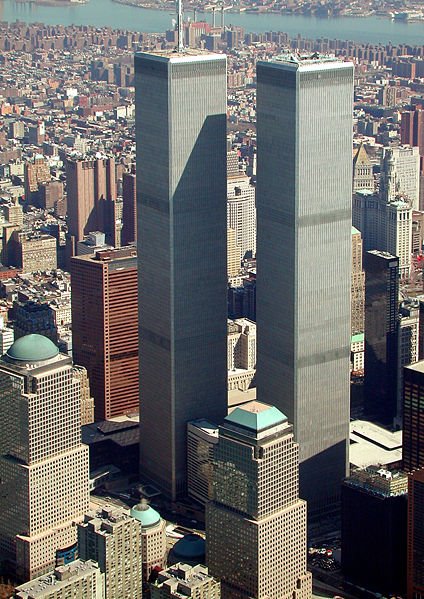
Forty years ago today, at 11:30 a.m. on December 23, 1970, the north tower of the original World Trade Center "topped out" when its highest piece of structural steel was hauled into place. At 1,370 feet, this made the World Trade Center the world's tallest building -- a title it would hold until the Sears Tower (now Willis Tower) in Chicago topped out until May 1973.

map courtesy of New York magazine.
As the Twin Towers reached their final height, people in the Bronx and Westchester began to notice a problem: their television signals were becoming blurred or full of static. Late in the design phase of the World Trade Center, engineers had realized that VHF television signals beamed from the top of the Empire State Building would hit the Twin Towers and bounce back 35 millionths of second later; this may not seem like much, but it was enough of a delay that people in the path of the second signal -- see map, left -- ended up with interference. The problem was going to last until new television antennas could be affixed to the top of the World Trade Center; in the meantime, broadcasters came up with a stop-gap measure of broadcasting on a separate UHF frequency. The only problem? Many televisions in 1970 didn't have UHF built in, and a converter cost $25.

In September 1970, New York magazine ran a long story entitled "Is the World Trade Center Worth All the Problems It's Causing New York," detailing the television broadcasting woes, along with other complaints that were commonly leveled against the complex: it's too big; the Port Authority is wasting money on real estate; there will be too many people flooding into Lower Manhattan for the the subways to handle. Other interesting information from the piece (which you can read here):
  • There was talk of extending the soon-to-be-built Second Avenue subway south of 34th Street to accommodate the added Wall Street traffic.
  • Another subway proposal: build "people movers" from the WTC to the Lexington Avenue and Second Avenue lines.
  • It was estimated that only 2,000 people out of 150,000 a day were going to use the Hudson Tubes (aka the PATH train) to commute to the World Trade Center.
  • The Port Authority was asking WTC tenants to stagger their work schedules so as to ease the burden on the subways.
A portable Sony color TV in 1970 runs you $309.95
The money quote comes from then-Congressman Ed Koch: "Public funds ought to be used for better purposes, such as mass transit. This is antiseptic.... [David] Rockefeller is leveling everything and putting up clean towers that match the Chase Manhattan Bank. I place the blame for this on him."

Were you around in 1970 when the television signals went haywire? If so, let us know in the comments.


* * *


Read more about the rise and fall of the World Trade Center in


To get RSS feeds from this blog, point your reader to this link.
Or, to subscribe via email, follow this link.
Also, you can now follow us on Twitter.

Friday, February 26, 2010

The First World Trade Center Bombing

Today marks the 17th anniversary of the 1993 World Trade Center bombing that killed six people and injured over 1,000 more.

The plot and bombing were carried out by seven men: Mohammed Salameh, Ramzi Yousef, Mahmud Abouhalima, Nidal Ayyad, Abdul Rahman Yasin, Ahmad Ajaj, and Eyad Ismoil.

On the morning of February 26, 1993, Ismoil and Yousef drove a rented Ryder van into Manhattan from Jersey City. According to author Simon Reeve in
The New Jackals, their intended destination may have been the United Nations, but finding the buildings too well secured, they switched to plan "B" and targeted the Twin Towers instead.

The van exploded at 12:17 p.m., tearing a huge hole in the  concrete foundations of WTC 1 (the north tower) and destroying a portion of the garage. The tower immediately lost power and all workers were evacuated; most of the injuries came during the scramble to get people to safety.


Investigators found the frame of the van and were able to pull its VIN, thus linking it back to Mohammed Salameh, who had rented the van and then reported it stolen. When Salameh returned to the Ryder agency in Jersey City to get back his $400 deposit, the FBI arrested him. The mastermind of the attack, Ramzi Yousef, returned to Jersey City that afternoon and immediately flew out of the country to Pakistan. He was not apprehended until after his involvement in the bombing of Philippine Airlines flight 434 in December 1994, a trial run in the so-called "Bojinka" plot to explode dozens of airlines. Yousef's uncle, Khalid Sheikh Mohammed, would ultimately be the force behind the second attack on the World Trade Center on September 11, 2001.

Eventually, all the conspirators in the 1993 World Trade Center bombing were arrested and incarcerated except for Abdul Rahman Yasin, who was last seen in Iraq in 2003 and has not been seen or heard from since.

The six fatalities at the World Trade Center in 1993 were John DiGiovanni (age 45), Robert Kirkpatrick (61), Stephen Knapp (48), Bill Macko (47), Wilfredo Mercado (37), and Monica Smith (35), who was seven months pregnant at the time of her death. A memorial to them that once stood in the plaza at the World Trade Center was destroyed on 9/11; a new tribute to these victims will be included when the "Reflecting Absence" memorial opens -- supposedly by September 11th next year.

* * *


Read more about the construction of the World Trade Center
in
 Inside the Apple: A Streetwise History of New York City
.
To get RSS feeds from this blog, point your reader to this link.
Or, to subscribe via email,
 follow this link.Also, you can now follow us on Twitter.


Search This Blog

Blog Archive