GET UPDATES IN YOUR INBOX! Subscribe to our SPAM-free updates here:

GET UPDATES IN YOUR INBOX! Subscribe to our SPAM-free email here:

Delivered by FeedBurner

Showing posts with label Frank Lloyd Wright. Show all posts

Thursday, January 11, 2018

Postcard Thursday: Skyrise for Harlem

Skyrise for Harlem; Esquire magazine, April 1965
There's a terrific exhibit at the Queens Museum called "Never Built New York," that features dozens of plans for unbuilt architecture that would have remade the city. (The show only runs through February 18, so catch it while you can.)

When we were visiting the show in October, we were struck by the plan from 1965 to tear down much of Harlem and replace it with giant, 100-story towers (seen above). James researched the subject further and his essay on "Skyrise for Harlem" appeared yesterday in Curbed NY. The story not only outlines the plan -- which architect Buckminster Fuller created with writer June Jordan -- but also looks at how Harlem real estate transformed during the late 19th and early 20th centuries.

You can read the story here: https://ny.curbed.com/2018/1/10/16868494/harlem-history-buckminster-fuller-development-rezoning.

From the ARCH/CAEHT plan for the East Harlem Triangle redevelopment; from the Louisiana State University archives

Fuller and Jordan weren't the only planners who were trying to figure out how to improve housing conditions in Harlem in the 1960s. The drawing above is from the Architects’ Renewal Committee in Harlem's suggested plan for the rezoning of the East Harlem Triangle. As James notes in his article:
In 1964, the Architects’ Renewal Committee in Harlem (ARCH) was founded to serve, in the words of architectural historian Brian D. Goldstein, as a “community design center” but then transformed—as the influence of black nationalism became more prominent in Harlem’s political life—into a way to “resist and revise official urban development plans".... Take, for example, the ARCH proposal for the East Harlem Triangle redevelopment.... The city’s plan was to turn the area—the triangle bounded by Madison Avenue, 125th Street, and the Harlem River—into an industrial zone. Pushback from the newly formed Community Association of the East Harlem Triangle (CAEHT) convinced the city to consider alternate proposals. Working with CAEHT, the planners at ARCH, led by its director, African-American architect J. Max Bond Jr., produced a plan that would not only radically transform the East Harlem Triangle, but would create a “distinctively black and democratic urban space.” 
As opposed to “Skyrise for Harlem,” the East Harlem Triangle plan advocated the preservation of newer townhouses and tenements, while new construction would preserve “positive features of the present living patterns".... On a reconfigured 125th Street, most of the traffic is eliminated in favor of wide sidewalks and tree-lined medians with bench seating. Typical examples from the urban planning wishlist are present, like a dedicated lane for bus traffic, while very specific symbols of Harlem abound: the bus boasts an ad for Muhammad Speaks, the newspaper of the Nation of Islam. A man in a dashiki stands in the median, while a woman on the sidewalk raises a black power salute.
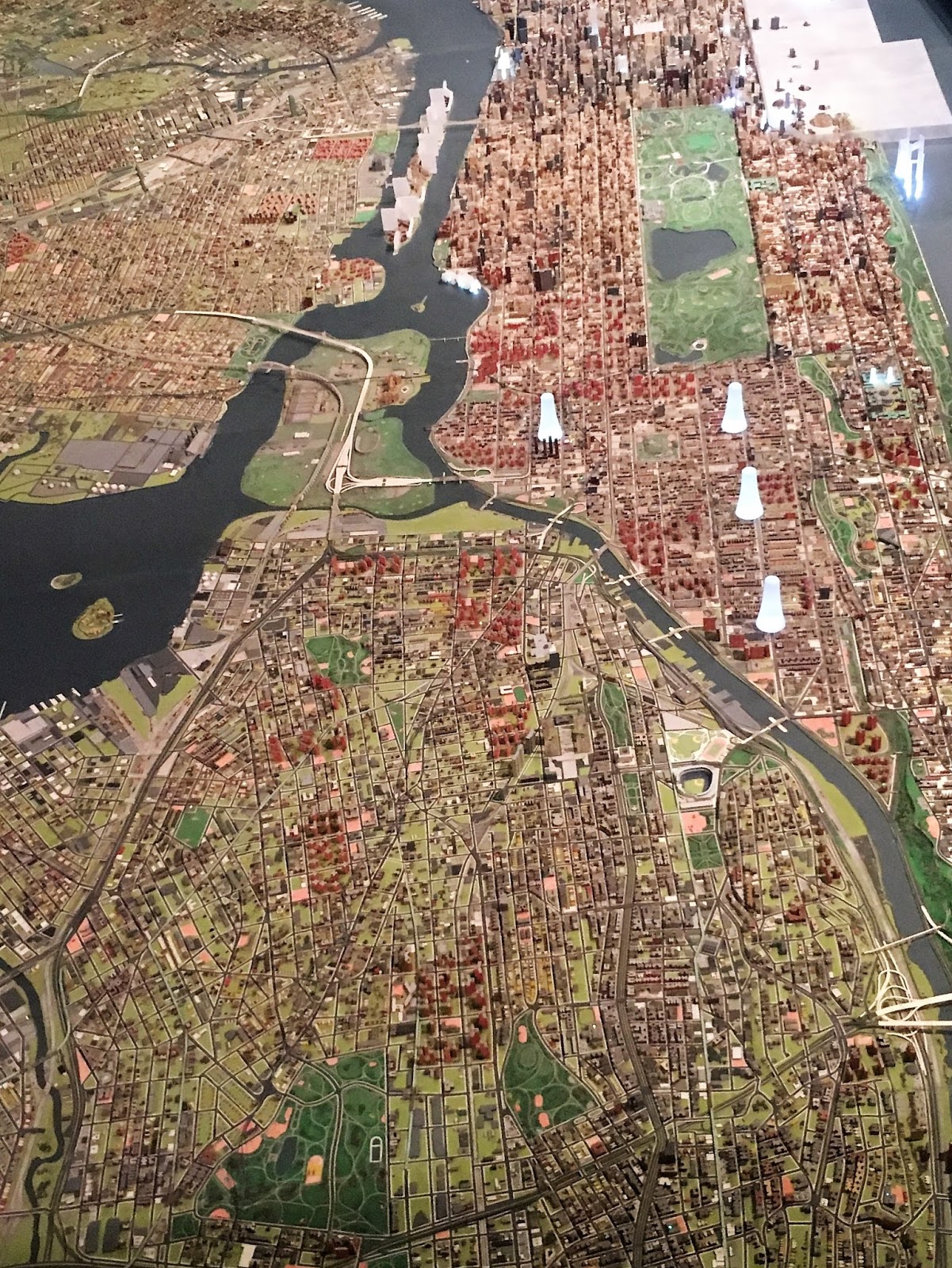
The Queens Museum panorama, with some of the Fuller/Jordan Skyrise towers superimposed over Harlem

* * *
Speaking of Curbed, three of James's pieces were singled out for the "Best of 2017" lists for both the local and national sites this year:

Thursday, December 7, 2017

Postcard Thursday: Planned Communities

courtesy of Tudor City Confidential

James has a story in today's New York Post about planned communities -- from Tudor City (above) to Garden City, Long Island, to Battery Park City -- and their utopian overtones.


* * * 


Thursday, September 14, 2017

Postcard Thursday: Frank Lloyd Wright in NYC


In today's New York Post, reporter Lauren Steussy takes a peek inside Crimson Beech, the only home in New York City designed by celebrated architect Frank Lloyd Wright.

To accompany that article, James has written a piece about other ways to explore Wright's legacy in New York. You can read it at http://nypost.com/2017/09/13/experience-frank-lloyd-wrights-work-across-nyc-and-beyond/

And to read more of James's work on Wright check out:

↘↗↘
Read more about NYC history in


Thursday, June 22, 2017

Postcard Thursday: Frank Lloyd Wright at MoMA

Model of the Price Tower in Bartelsville, OK

If you haven't yet had the chance, we highly recommend heading over to the Museum of Modern Art to see "Frank Lloyd Wright at 150: Unpacking the Archive," a wonderful collection of architectural drawings, renderings, and models. The show, curated by Columbia University's Barry Bergdoll, spans Wright's career from early work in and around Oak Park, Illinois, to his final, unrealized plans for a mile-high skyscraper. Many of the works on display are for commissions that were never brought to fruition -- and some, like that skyscraper, weren't even commissions -- and it's a rare treat to see these lesser-known ideas.

The exhibition runs through October 1, 2017. As preparation, you might want to check out some of James's recent work on Wright:

Frank Lloyd Wright. March Balloons. 1955. Drawing based on a c. 1926 design for Liberty magazine. Colored pencil on paper, 28 1/4 x 24 1/2" (71.8 x 62.2 cm). The Frank Lloyd Wright Foundation Archives (The Museum of Modern Art | Avery Architectural & Fine Arts Library, Columbia University, New York)

Thursday, June 8, 2017

Postcard Thursday: Frank Lloyd Wright at 150

The blueprints for Fallingwater, often called Frank Lloyd Wright's masterpiece
Today, June 8, marks the 150th birthday of Frank Lloyd Wright, who is considered by many to be America's most significant architect.

In his honor, Curbed has devoted a series of articles to Wright's work and legacy, and James wrote the one that looks at his early work in and around Chicago. Titled "Becoming Frank Lloyd Wright," the piece argues that even before the advent of the Prairie Style, Wright was incorporating architectural elements that he would revisit throughout his career.

You can read the story here: https://www.curbed.com/2017/6/8/15749604/prairie-school-chicago-early-frank-lloyd-wright

And check out the rest of Curbed's #FLW150 celebration at https://www.curbed.com/2017/6/8/15729452/frank-lloyd-wright-guide-legacy

* * * *
In other news.... reservations are now open!

On Sunday, June 25, at 11:00 am, we will be conducting a walking tour of The History of the Bowery.


From country road to immigrant entertainment district to Skid Row (and beyond), the Bowery has witnessed New York's rich history. Together, we will explore 400+ years of New York's story along this famous thoroughfare.

The tour is $20 per person for those who reserve before Tuesday, June 21 (when the price goes up to $25 per person).

To reserve, send an email to walknyc@gmail.com with

  • Your name
  • The number in your party
  • And a cell phone where we can contact you the morning of the tour if there's any problems


    Details of where to meet will be emailed to you within 24 hours of receiving your reservation.

This walk may sell out, and reservations are being taken on a first-come, first-served basis, so RSVP soon!

Thursday, May 11, 2017

Postcard Thursday: Secret Gardens


The iconic photo above, from Woody Allen's Manhattan, was taken at the edge of East 58th Street, in a tiny park that abuts a private enclave known as Sutton Square.

James explored Sutton Square -- where 5 townhouses happen to be on the market at the moment -- for a story in today's New York Post.

You can read the piece at: http://nypost.com/2017/05/11/what-its-like-to-live-on-one-of-nycs-secret-gardens/

For the next couple of weeks, we are on the road exploring sites associated with pioneer author Laura Ingalls Wilder (of Little House on the Prairie fame) and renowned architect Frank Lloyd Wright. If those topics interest you, be sure to follow James on social media to see photos from along our route.

Instagram: https://www.instagram.com/james_nevius/

Facebook: https://www.facebook.com/JamesNeviusAuthor

Twitter: https://twitter.com/JamesNevius

* * * *
Read more about NYC history in


Monday, March 20, 2017

Postcard Thursday: Frank Lloyd Wright


We've had some glitched before with Postcard Thursday. Astute readers know that is sometimes appears as Postcard Friday, and there might have even been a Postcard Saturday once upon a time.

But Postcard Monday?

Mea culpa.

Today brings you a snowy scene of Frank Lloyd Wright's masterpiece, Fallingwater, which James wrote about this week in The New York Post. Read all about how to construct your own Wright road trip at http://nypost.com/2017/03/13/roadtripping-frank-lloyd-wrights-greatest-archi-hits/


* * * *
Read more about NYC history in


Thursday, January 5, 2017

Postcard Thursday: Frank Lloyd Wright's Broadacre City


Yesterday, James had a piece in CURBED, the online real estate and architecture journal, about Frank Lloyd Wright's least-understood concept, "Broadacre City," a type of suburban Utopia he first envisioned in the 1930s.

As James writes in the story:
If you read enough about Frank Lloyd Wright, a standard narrative begins to emerge: There’s early Wright, where the brash young architect breaks from his Chicago School mentors to create the Prairie style and design such early icons as the Robie House in Chicago and Tokyo’s Imperial Hotel. Then there’s late Wright, the mature genius who brought us Fallingwater and the Guggenheim Museum. In between, there’s a fallow period of personal scandal, a slowdown in commissions, and oddball musings, such as his 1932 plan for a utopian, libertarian community he called Broadacre City.

Though Wright remains America’s most famous architect, his Broadacre theories are often relegated to a footnote of his career; indeed, many biographies don’t mention them at all. But what if the Broadacre plan—a sweeping, individualized American “anti-city” that fused Jeffersonian and Hamiltonian ideals into a seamless, Wright-designed, suburban landscape—was, in fact, the architect’s most enduring idea?


(And read more about the architect's famous Guggenheim Museum commission at http://blog.insidetheapple.net/2010/10/remembering-opening-day-at-guggenheim.html.)


Thursday, October 21, 2010

Remembering Opening Day at the Guggenheim

In all the brouhaha surrounding the Solomon R. Guggenheim museum's plan to place a food kiosk outside the museum (a request unanimously denied by the Landmarks Preservation Commission, despite Frank Lloyd Wright's love of hot dogs), there's been little or no mention of the fact that today is the Guggenheim's 51st birthday. The museum opened on October 21, 1959, to mixed reviews. From the conception to completion the project took 16 years, but alas, Wright--who died six months before its completion--never got to enjoy the finished space.

Planning czar Robert Moses--Wright's second cousin by marriage--did not always see eye-to-eye with the famed architect. (In his opening remarks he said, "We need not debate how much of cousin Frank was genius and how much was, let us say, showmanship." In another context, he referred to his cousin as the man "regarded in Russia as our greatest builder.") But Moses made sure the Guggenheim got built. When the Department of Buildings was dragging its feet on giving the museum the proper approvals, Moses called the commissioner and told him: "I will have a building permit on my desk at 8:00 a.m. tomorrow or there will be a new building commissioner."

Many of Wright's colleagues praised the new museum. Philip Johnson called it "Mr. Wright's greatest building. New York's greatest building." Edward Durell Stone, who had worked on the Museum of Modern Art and would go on to build Huntington Hartford's Gallery of Modern Art on Columbus Circle, noted "I personally think it's a wonderful museum.... Why can't people relax and enjoy a fantastic structure instead of continually carping and criticizing."

And carp and criticize they did. The
New York Mirror compared it to a "ball of mud" and an "imitation beehive that does not fit in any New York environment." Others drew comparisons to a Jello mold or a washing machine. The biggest complaint was that it would be a terrible space to show art (a critique that still plagues certain shows at the museum.)
If you are on the Upper East Side today, swing by and admire Wright's greatest New York creation and wish it a happy birthday.


* * *


Read more about Frank Lloyd Wright and the Guggenheim Museum in


To get RSS feeds from this blog, 
point your reader to this link.
Or, to subscribe via email, 
follow this link.
Also, you can now 
follow us on Twitter.

Search This Blog

Blog Archive