GET UPDATES IN YOUR INBOX! Subscribe to our SPAM-free updates here:

GET UPDATES IN YOUR INBOX! Subscribe to our SPAM-free email here:

Delivered by FeedBurner

Showing posts with label Harlem. Show all posts

Thursday, December 20, 2018

Postcard Thursday: The Year at Curbed

The Elevated Railway near Morningside Park
'Tis the season for year-end wrap-ups and "Best of 2018" lists.

James is pleased to have been awarded two slots in Curbed New York's list of  the "Thirteen Best Longreads of 2018" for his history of Co-op City in the Bronx and his look back at the 150th anniversary of the first elevated railway to be erected in the city.

If you aren't already a reader of Curbed NY, it is a great resource for journalism on architecture, urbanism, transportation, and more. The other stories in the "best of" list include Karrie Jacobs's trek to La Guardia airport on foot, Nathan Kensinger's photo essays about Canal Street and Long Island City, and a first-hand look at "glamping" on Governors Island.

Check out the entire list at https://ny.curbed.com/2018/12/19/18146998/best-longreads-new-york-city-history-architecture-2018.

James had a number of other pieces published by Curbed NY this year, including


Thank you for your support this year. We hope everyone has a wonderful holiday season!

Michelle and James Nevius


If you are looking for a great gifts this holiday season, Inside the Apple and Footprints in New York look great on anyone's shelves!


Thursday, January 11, 2018

Postcard Thursday: Skyrise for Harlem

Skyrise for Harlem; Esquire magazine, April 1965
There's a terrific exhibit at the Queens Museum called "Never Built New York," that features dozens of plans for unbuilt architecture that would have remade the city. (The show only runs through February 18, so catch it while you can.)

When we were visiting the show in October, we were struck by the plan from 1965 to tear down much of Harlem and replace it with giant, 100-story towers (seen above). James researched the subject further and his essay on "Skyrise for Harlem" appeared yesterday in Curbed NY. The story not only outlines the plan -- which architect Buckminster Fuller created with writer June Jordan -- but also looks at how Harlem real estate transformed during the late 19th and early 20th centuries.

You can read the story here: https://ny.curbed.com/2018/1/10/16868494/harlem-history-buckminster-fuller-development-rezoning.

From the ARCH/CAEHT plan for the East Harlem Triangle redevelopment; from the Louisiana State University archives

Fuller and Jordan weren't the only planners who were trying to figure out how to improve housing conditions in Harlem in the 1960s. The drawing above is from the Architects’ Renewal Committee in Harlem's suggested plan for the rezoning of the East Harlem Triangle. As James notes in his article:
In 1964, the Architects’ Renewal Committee in Harlem (ARCH) was founded to serve, in the words of architectural historian Brian D. Goldstein, as a “community design center” but then transformed—as the influence of black nationalism became more prominent in Harlem’s political life—into a way to “resist and revise official urban development plans".... Take, for example, the ARCH proposal for the East Harlem Triangle redevelopment.... The city’s plan was to turn the area—the triangle bounded by Madison Avenue, 125th Street, and the Harlem River—into an industrial zone. Pushback from the newly formed Community Association of the East Harlem Triangle (CAEHT) convinced the city to consider alternate proposals. Working with CAEHT, the planners at ARCH, led by its director, African-American architect J. Max Bond Jr., produced a plan that would not only radically transform the East Harlem Triangle, but would create a “distinctively black and democratic urban space.” 
As opposed to “Skyrise for Harlem,” the East Harlem Triangle plan advocated the preservation of newer townhouses and tenements, while new construction would preserve “positive features of the present living patterns".... On a reconfigured 125th Street, most of the traffic is eliminated in favor of wide sidewalks and tree-lined medians with bench seating. Typical examples from the urban planning wishlist are present, like a dedicated lane for bus traffic, while very specific symbols of Harlem abound: the bus boasts an ad for Muhammad Speaks, the newspaper of the Nation of Islam. A man in a dashiki stands in the median, while a woman on the sidewalk raises a black power salute.
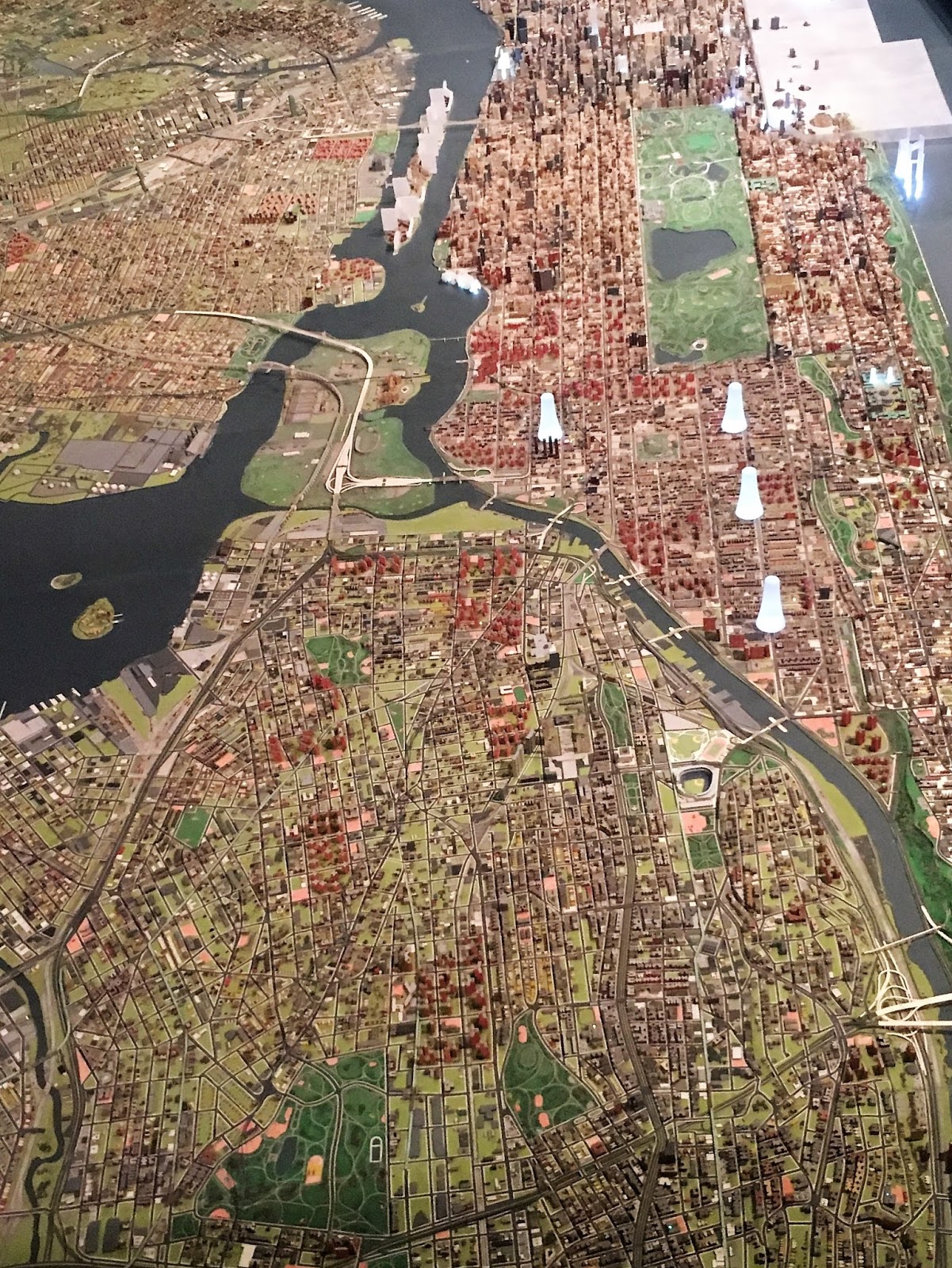
The Queens Museum panorama, with some of the Fuller/Jordan Skyrise towers superimposed over Harlem

* * *
Speaking of Curbed, three of James's pieces were singled out for the "Best of 2017" lists for both the local and national sites this year:

Thursday, January 26, 2017

Postcard Thursday: The Apollo Theater


On January 26, 1934, the Apollo Theater opened on 125th Street in Harlem. Though the building it was housed in was twenty years old, the new theater reflected the changing demographics of the neighborhood. Previously known as the Harlem Opera House, the theater had presented a long-running burlesque show to an all-white audience. With its rebirth as the Apollo, the space would now welcome black audiences and changing its programming accordingly.

As we write in Inside the Apple:
The Apollo Theater, originally a whites-only burlesque house, reopened in 1934 with “Jazz a la Carte” and soon inaugurated its famed Amateur Night. One early winner, Ella Fitzgerald, became a fixture on the Harlem music scene with a regular gig at the Savoy Ballroom. By the mid-1930s, every prominent black musician in America—including Eubie Blake, Louis Armstrong, Bessie Smith, Fletcher Henderson, and Dinah Washington—was performing in Harlem. Indeed, many of these musicians could perform nowhere else, as strict musicians’ union codes kept them from downtown theaters because of their race.

A major refurbishment in 1985 launched "Showtime at the Apollo" as a national television program; more recent renovations have restored the facade and interior to their 1930s glory.


* * * *


Thursday, August 30, 2012

Thurgood Marshall's Harlem

Forty-five years ago today, on August 30, 1967, Thurgood Marshall was confirmed as the first African American Supreme Court justice. Prior to serving on the Supreme Court, Marshall was most famous as chief counsel of the NAACP, based primarily in New York City. As the NAACP's attorney, Marshall argued 32 cases in front of the U.S. Supreme Court (winning 29 of them), most notably Brown v. Board of Education, which struck down the notion of "separate but equal" in public school education and beyond.

For many years, the NAACP was headquartered at 224 West 135th Street, near Adam Clayton Powell Jr Blvd.  In many ways, 135th Street was the most important street in the neighborhood. In addition to the NAACP, it was home to the YMCA, where many Harlemites stayed when they first arrived in New York, and was the epicenter of theaters and clubs where the Harlem Renaissance flowered. At the corner of 135th and Adam Clayton Powell was once a nightclub called Small's Paradise, famous for its rolling skating wait staff. Small's is long gone -- today the building houses an IHOP -- but above it is the Thurgood Marshall Academy, one of the best high schools in the area.

Around the corner on 134th Street is St. Philip's Episcopal Church, built in 1911 by the firm of Tandy & Foster, New York's first licensed African American architects. This was Thurgood Marshall's parish during his time in Harlem in the 1940s and 50s.

Many prominent African Americans (including the church's architect, Vertner Tandy) lived on nearby Striver's Row, considered by many to be the nicest development in the area. Marshall, however, opted to live further north in Sugar Hill, at 409 Edgecombe Avenue, a large apartment building built by Schwarz and Gross in 1917. Perhaps the single best address in Harlem, the building also housed W.E.B. DuBois, singer Julius Bledsoe, New York judge Eunice Carter, painter Aaron Douglas, and Roy Wilkins, the head of the NAACP.

Today, a one-bedroom apartment at 409 Edgecombe Avenue, which has gone coop, runs about $300,000. But back in the 1970s the building had fallen into such disrepair that the city seized it for nonpayment of taxes. In 1994, the New York Times reported that the city was preparing to sell the building back to its tenants for $250 per apartment. (That's not a typo.)

* * *
Read more about Harlem and the Harlem Renaissance in


Follow us on Facebook * Twitter * or via Email


Friday, January 29, 2010

J.D. Salinger's Early Life on the West Side

J.D. Salinger on the cover of Time, 1961


Yesterday brought the sad news of the death of J.D. Salinger, author of the classic New York tale Catcher in the Rye.
The New York Times obit mentioned briefly that Salinger had been born in Harlem, so we decided to do a little digging and found that he'd been born just south of Trinity Cemetery at 3681 Broadway (at 153rd Street). The building, Halidon Court, was built in 1910 and designed by Emery Roth, who would later go on to build such famous Upper West Side edifices as the Eldorado and the Beresford -- and another of Salinger's future homes. This handsome building still stands.
The Salinger family moved within a year of J.D.'s birth to an apartment on the Upper West Side at 113th Street and Riverside Drive. According to biographer Paul Alexander, "between 1919 and 1928, the Salingers moved three more times before they ended up in a pleasant apartment on West Eighty-second Street."

That "pleasant" apartment was at the Myron Arms at 221 West 82nd Street, then a relatively new building, which had also been designed by Emery Roth. Though Salinger moved out of the neighborhood for the Upper East Side, Salinger later attended the McBurney School on West 64th Street for two years before flunking out. The McBurney School appears in Catcher in the Rye; it's the school to which the fencing team is heading when Holden leaves the foils on the subway. (The school later moved from West 64th Street and that original building no longer stands.)

The Myron Arms is still there, however -- just across the street from Barnes & Noble -- so if you're heading in that direction to replace your dog-eared copy of
Catcher in the Rye or Nine Stories
, take a moment to admire Salinger's boyhood home. 


* * *


Read more about the Upper West Side -- and take a self-guided walking tour -- inInside the Apple: A Streetwise History of New York City.
To get RSS feeds from this blog, point your reader to this link.
Or, to subscribe via email, follow this link.
Also, you can now follow us on Twitter.

Saturday, November 29, 2008

"Keep the Faith, Baby!": Adam Clayton Powell Jr. Turns 100

Today (Saturday, November 29) marks the 100th birthday of Congressman Adam Clayton Powell, Jr., who was pastor of Abyssinian Baptist Church (which is turning 200 years old this year) and Harlem’s congressional representative from 1945 until 1971. (Powell died in 1972.)

Powell’s father, Rev. Adam Clayton Powell, Sr., was pastor at Abyssinian Baptist from 1909 to 1936, during which time the church moved to Harlem and became the largest protestant parish in the world with over 12,000 members. Adam Clayton Powell, Jr.—at that time the assistant pastor of the church—rose to fame by leading a boycott of shops along 125th Street that would sell to African-American shoppers but would not hire them to work at the stores. This “Don’t Shop Where You Can’t Work” movement boosted Powell’s political prominence; in 1937, Adam Clayton Powell, Jr., took over the pulpit at Abyssinian Baptist, and in 1941 he became New York’s first black city council member. In 1944, he was elected to the House of Representatives—the first African-American from New York—and served until 1970, when he was replaced by Charlie Rangel. (Together, that means that Harlem has been represented by only two men for the past 63 years!) In congress, Powell was integral to the Civil Rights movement and as chairman of the Committee on Education and Labor saw to it that legislation on school lunches, student loans, and the minimum wage got passed.

The Schomburg Center for Research in Black Culture is hosting an all-day event beginning at 11:00AM celebrating Powell’s life and accomplishments. (Birthday cake will be served at 4:00PM.)

Two interesting side notes about Powell:

·         The mammoth building at 125th Street that now bears his name was one of the last things he adamantly opposed as Harlem’s representative. He at one point threatened to leave New York and settle permanently in his second home in Bimini should the building be constructed. When it first opened in 1974, it was simply the “State Office Building in Harlem”—Powell’s name was not attached until 1983.

·         In 1960, he slandered a constituent, Esther James, claiming she was a “bag woman” for the Mafia. James sued and was awarded $46,000 that Powell refused to pay. When charged with contempt, Powell would only come back to Harlem on Sundays—when civil contempt subpoenas could not be served—to preach at Abyssinian Baptist. A judge eventually gave Powell more time to come up with the money and one way he attempted to raise funds was by issuing a spoken word LP, Keep the Faith, Baby!, containing some of his most famous speeches.


* * *

As always,  more information about Powell and the history of Harlem can be found in our book, Inside the Apple, which is coming out in March but is available for pre-order today.


* * *

Use this link to subscribe to RSS feeds from this blog. Or, to subscribe via email, follow this link.

Search This Blog

Blog Archive