GET UPDATES IN YOUR INBOX! Subscribe to our SPAM-free updates here:

GET UPDATES IN YOUR INBOX! Subscribe to our SPAM-free email here:

Delivered by FeedBurner

Thursday, September 25, 2014

Postcard Thursday: Hudson-Fulton Celebration

Collection of the authors.

On September 25, 1909, New York launched one of the largest and most ambitious festivals in its history, the enormous Hudson-Fulton Celebration, which commemorated 300 years since Henry Hudson had sailed into New York Harbor, and a century (give or take a couple of years) since Robert Fulton's North River Steamboat had been launched.

This rare, embossed postcard emphasizes the improvements in navigation over three centuries.
Collection of the authors.

Among the many events that took place during the celebration (some of which can be seen in the small type at the bottom of the top postcard) was a naval parade that included everything from replicas of Hudson's ship Half Moon and Fulton's sidewheeler steamer to the RMS Lusitania. As a nod to the direction in which transportation was headed, Wilbur Wright took to the air as well, circling the Statue of Liberty on one day, and flying up the Hudson to Grant's Tomb and back to Governor's Island on another. In 1909, it's safe to say most New Yorkers had never seen an airplane flight before.

Of the many parades connected to the festival, the Historical Parade in New York City on September 28 was probably the most important. The entire celebration was an attempt to boost New York (the state, but mostly the city) in the public's mind as key player in American history. As the commission noted in their wrap-up after the festival:
A glance at the book-shelves of any great public library will show how industrious the historians of Massachusetts and Pennsylvania and Virginia have been in recording the annals of which they are justly proud and how comparatively indifferent our own writers have been in this field. And this disparity has resulted in a very general ignorance of the full part played by our Colony and State in our national history.
courtesy of Hudson River Valley Heritage.

The Historical Parade featured floats from every period of New York's history, from the Native American era to 1909, with a special emphasis on the city's Dutch roots and its role in the American Revolution (as shown in the float above). You can see many more postcards of floats from the parade -- along with souvenir programs from 1909 and other ephemera -- at the Hudson River Valley Heritage website dedicated to the celebration.

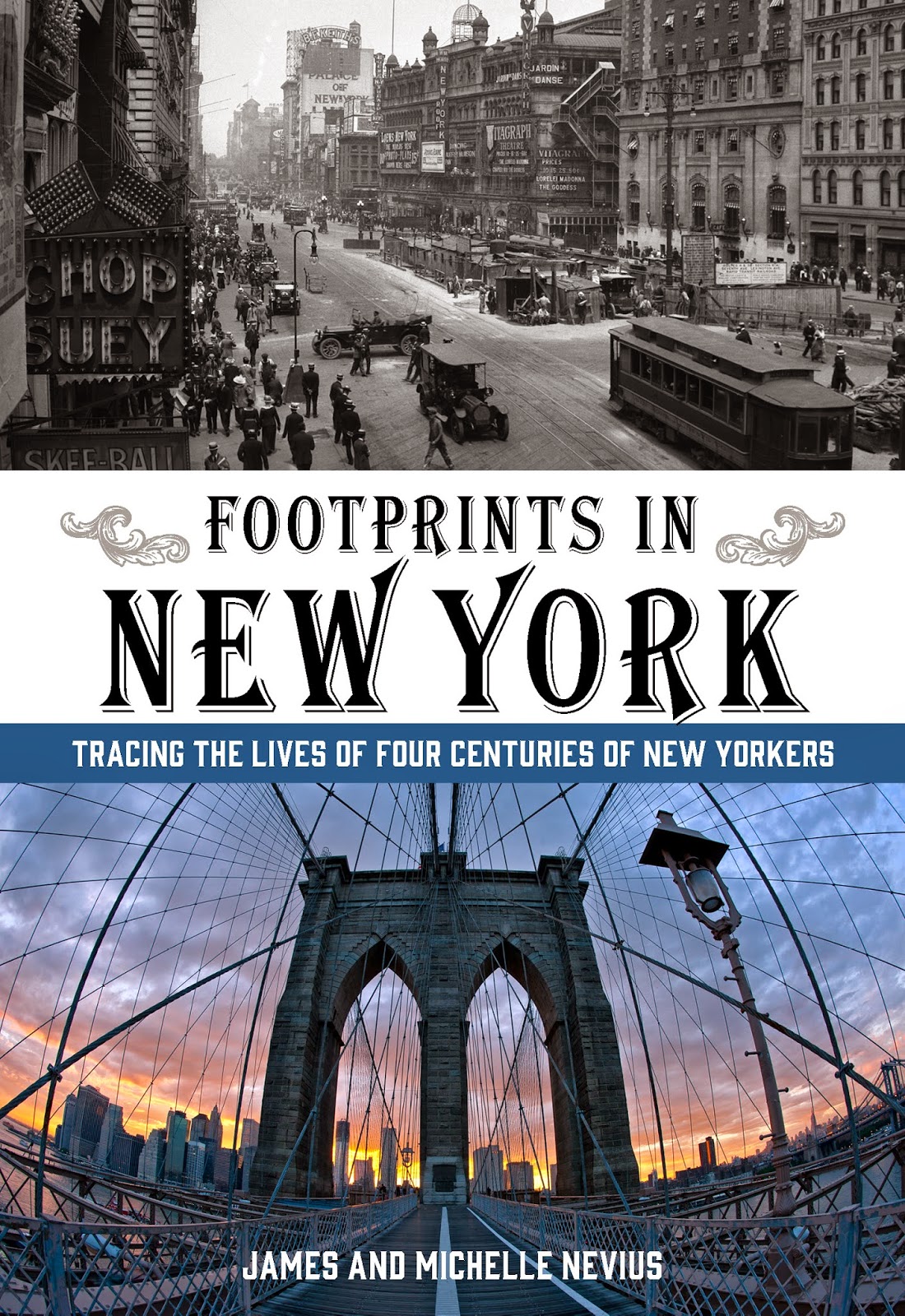
A century later, in 2009, the city once again celebrated the arrival of Henry Hudson (albeit in a somewhat more subdued fashion). One permanent souvenir from that celebration is the Dutch pavilion in Peter Minuit Plaza in the financial district, which we write about in the first chapter of Footprints in New York.


* * * *

Explore more NYC history in

If you haven't had a chance to pick up a copy of Footprints yet,
you can order it from your favorite online retailers (AmazonBarnes and Nobleetc.) or

And, of course, Inside the Apple is available at fine bookstores everywhere.

Friday, September 19, 2014

Columbus Weekend: Sunday walking tour / Monday book talk + signing

If you are going to be in New York City over the Columbus Day weekend, we have two Footprints in New York events that might interest you:

_______________________________
Sunday, October 12, 2014, at 4:00PM
New York City's 350th Birthday Walk
$15 - tour only
$25 - tour and copy of Footprints in New York

In September 1664, Peter Stuyvesant handed over the Dutch colony of New Netherland to the English, who renamed it New York. A month later, the English authorities required all Dutch citizens to swear an oath of allegiance to King Charles II, kicking off a century of uneasy relations between the crown and New York's multicultural residents.

Join us for a walk through the streets of Lower Manhattan as we time travel back to the late-17th and early-18th centuries to walk in the footprints of these early New Yorkers, including the powerful Delanceys, Van Cortlandts, Stuyvesants, Morrises, and more.

RSVP REQUIRED
To sign up for the walk please email the following to
footprintsinnewyork@gmail.com

  • Name
  • Number in your party
  • Cell number in case we need to reach you on the day of the tour
  • How many people are tour only ($15 each) or tour + a copy of our new book Footprints in New York ($25 each)
MEETING PLACE WILL BE EMAILED TO YOU WHEN YOU RSVP

________________________________
Monday, October 13, 2014 at 6:30PM
"Footprints in Greenwich Village"
An illustrated talk sponsored by the Greenwich Village Society
for Historic Preservation
Washington Square Institute (41 East 11th Street between Broadway and University Place)

In a talk illustrated with vintage photos and old maps, we will focus on the stories in Footprints in New York that are connected to Greenwich Village, from Peter Stuyvesant’s bowery to Bob Dylan’s MacDougal Street.

One part history, one part urban exploration, Footprints in New York follows in the steps of such dynamic Village residents as Edgar Allan Poe, Gertrude Tredwell (of the Merchant’s House Museum), Henry James, John Reed, and many more.

We will take audience questions, and books will be available for purchase and signing following the talk.

The talk is free, but reservations are required. To register, please call the Greenwich Village Society for Historic Preservation at (212) 475-9585 ext. 35 or email.

Thursday, September 18, 2014

Postcard Thursday: Archibald Kennedy

A print of the Kennedy Mansion from NYPL.org
In honor of the referendum today on Scottish independence, here's an edit of a blog post we wrote back in 2009 about Archibald Kennedy, who lived in a grand house at One Broadway and would later become the 11th Earl of Cassilis (and is James's distant relative).

Today, the building at One Broadway is the former headquarters of International Mercantile Marine, JP Morgan's shipping and passenger ship company. But back in the 18th century, the base of Broadway was home to Archibald Kennedy, New York's receiver-general (i.e., the customs collector).

Kennedy built his mansion ca. 1760; because Broadway was then much closer to the Hudson, Kennedy would have had a fine view out over the harbor and in the summer of 1776, he would have seen the massive British fleet assembling beyond Staten Island. Between June 29 and August 12, nearly 200 ships arrived, the largest naval fleet since antiquity. One observer, a soldier named Daniel McCurtin, wrote in his journal:
"[I] spied as I peeped out the Bay something resembling a wood of pine trees trimmed.... I declare I thought all of London was afloat."
During the war, Kennedy left the city and the house became George Washington's headquarters during the planning of the Battle of Brooklyn, which took place in late August 1776. When the British captured New York, the home -- which escaped the Great Fire of 1776 -- was used by the British army. After the Revolution, the house was rented by Isaac "King" Sears. A prominent member of the Sons of Liberty, Sears was was involved in the Stamp Act Protests in 1765 and the Battle of Golden Hill in 1770, a skirmish just north of Wall Street that some call the first bloodshed of the Revolution. Sears paid £500 a year, probably the highest rent in the city.

In 1792, Kennedy's distant cousin, the 10th Earl of Cassilis, died without an heir and the title passed to Archibald. It is unclear is Kennedy had moved back to New York after the British lost the Revolution; we do know that upon the death of the 10th Earl, Kennedy moved to Scotland. However, he died just two years later. His son (another Archibald) became the 12th Earl and, later, the First Marquess of Alisa.

Back in New York, Kennedy's house had come to be owned by John Watts (Kennedy's second wife's brother), a successful merchant and founder of the Leake and Watts Orphan House in Morningside Heights.

By 1882, the home had become a boardinghouse and was demolished to make way for the Washington Building (which was later remodeled as the current International Mercantile Marine building). When the Washington Building was erected, it had more office space than any building in New York.

* * * *

Explore more NYC history in

If you haven't had a chance to pick up a copy of Footprints yet,
you can order it from your favorite online retailers (AmazonBarnes and Nobleetc.) or
from independent bookstores across the country.

And, of course, Inside the Apple is available at fine bookstores everywhere.


Thursday, September 11, 2014

Postcard Thursday: Belvedere Castle


We have a lot of wonderful Central Park shots in our collection, but this may be the best: Belvedere Castle as it looked ca. 1905.

Originally conceived as mere decoration, the castle stands on Vista Rock and was part of Frederick Law Olmsted's picturesque vision for the park. As we write in Footprints in New York, the castle is
an architectural folly built by Vaux and Mould in 1867. It was designed to do nothing more than provide the optical illusion for viewers at Bethesda Terrace that somewhere deep in the park was a giant castle. It was the pinnacle—excuse the pun—of Olmsted’s picturesque vision for the park. 
When the Central Park commissioners first saw the map of the Greensward Plan, I’m sure many of them didn’t realize how far-reaching Vaux and Olmsted’s design would be. The designers understood that in contrast to the monotony of the city...the park would embrace the natural topography. This would immediately mean that no two places in the park would be the same. On top of that, the tens of thousands of trees they would plant would provide “the broadest effects of light and shade . . . [producing] the impression of great space and freedom.” What an “exhilarating contrast” this would be, the designers wrote, from “the walled-in floor or pavements to which they are ordinarily confined by their business.” 
The greatest amounts of the park were to balance the principles of the picturesque—thick woods, painterly contrasts of light and shadow, and the occasional castle—with the pastoral: sweeping vistas, sloping greensward, open meadows, and an actual pasture.... To contrast with these open green spaces, Vaux and Olmsted and their chief gardener, Ignaz Pilat, planted wooded areas such as the Ramble and the North Woods, forty acres in the northwestern corner of the park that were landscaped to mimic an Adirondack forest, complete with ravines, rustic wooden bridges, and a “loch,” all straight out of an Asher Durand painting. 
Lastly, Olmsted and Vaux realized the importance of also including a formal centerpiece to the park. The Mall, one of the first areas of the park to open to the public, is not just a straight path, it runs exactly north- south and is lined with four rows of American elms. Pedestrians, led due north along the promenade, come to Bethesda Terrace, the artistic jewel of the park. 
The shock of this overt formality reminds viewers just how informal the rest of the park seems. Similarly, the picturesque touches—a wooden gazebo here, a fake castle there—create views that are almost too much like postcards. And so the mind says: Ah, well if these views are fake, everything else must be real.
Today, Belvedere Castle houses equipment for the national weather service. You can read more about an array of Calvert Vaux's architecture around the city in James's piece on Vaux that was published in Curbed a few weeks ago.

(And if you haven't had the chance, check out his history of St. Mark's Place from last Thursday, which takes readers on a 200-year journey down the East Village's most famous street.)

* * * *

Explore more NYC history in

If you haven't had a chance to pick up a copy of Footprints yet,
you can order it from your favorite online retailers (AmazonBarnes and Nobleetc.) or
from independent bookstores across the country.

And, of course, Inside the Apple is available at fine bookstores everywhere.


Thursday, September 4, 2014

No Postcard Thursday: St. Mark's Place


No postcard today -- we're on the road traveling. Instead, check out the piece that James had published today on Curbed tracing the history of St. Mark’s Place in the East Village. From its first appearance on the 1811 street grid to the swinging sixties to today, the article highlights some St. Mark’s Place’s famous and not-so-famous residents as well as looking at how the concept of an “East Village” first came about.

Check it out at
http://ny.curbed.com/archives/2014/09/04/the_strange_history_of_the_east_villages_most_famous_street.php.

* * * *

Explore more NYC history in

If you haven't had a chance to pick up a copy of Footprints yet,
you can order it from your favorite online retailers (AmazonBarnes and Nobleetc.) or
from independent bookstores across the country.

And, of course, Inside the Apple is available at fine bookstores everywhere.
Monday, September 1, 2014

The Ride Home with Pat Kiernan and Rita Cosby

Happy Labor Day!

If you are in NYC or environs and near a radio at 5:00 p.m. (driving back from your holiday weekend?), James will be appearing on “The Ride Home with Pat Kiernan and Rita Cosby” on 77 WABC Radio. If you live in the five boroughs and have Time Warner Cable, then you’re probably familiar with Pat as the NY1 news anchor who reads you highlights from the newspapers every morning. His afternoon radio show covers a variety of New York City topics and I’ll be talking with him and Rita about historical sites you can visit in New York that are part of our narrative in Footprints in New York (see below).

The show is also streamed live around the world at WABC via http://player.listenlive.co/25211 or if you have iHeartRadio app on your phone or tablet, WABC is also available (search for “77 WABC”).

If you can’t tune in at 5pm on Monday, there will be a podcast available sometime later in the week. We’ll post it to our Facebook page and Twitter account—so there’s no time like the present to follow us on social media.

* * *

If you’ve read Footprints, you know that we explore a number of sites that are off-the-beaten track in all five boroughs. We’ve recently added a “Resources” page to our website (http://www.footprintsinnewyork.com/resources.html) to help you visit some of these spots—from the Wyckoff House Museum in Brooklyn to Poe Cottage in the Bronx. The Resources Page is a work in progress, so if there’s something you’d like to see added, please let us know!


* * * *

Explore more NYC history in

If you haven't had a chance to pick up a copy of Footprints yet,
you can order it from your favorite online retailers (AmazonBarnes and Nobleetc.) or
from independent bookstores across the country.

And, of course, Inside the Apple is available at fine bookstores everywhere.


Thursday, August 28, 2014

Postcard Thursday: Elizabeth Ann Seton


Though you can't see it on this classic linen postcard view of St. Patrick's Cathedral, the church features magnificent front doors:


... and one of the figures on those doors is Saint Elizabeth Ann Seton, whose was born on August 28, 1774, which makes her America's first-born saint (not the first American to be sainted).


As we write in Inside the Apple:
Born Elizabeth Ann Bayley, Seton was the daughter of Columbia College’s renowned professor of anatomy, Richard Bayley, and a member of the de rigeur Episcopal parish, Trinity. In 1794, the Episcopal Bishop of New York officiated at her marriage to merchant William Seton and in 1801, the Setons moved into a waterfront house on State Street near the Battery. However, William Seton’s health was failing and just two years later the family moved out, embarking on what they hoped would be a restorative trip to Italy. 
Sadly, William died in Pisa shortly after their arrival. Rather than turn right around (for what was an exceptionally long sea voyage), Elizabeth stayed in Italy for a few months grieving—and discovering the Catholic Church. After returning to New York the next year, she began seriously considering conversion and in 1805 she was received into the Catholic faith—much to the chagrin and embarrassment of her friends and relatives.
Had Elizabeth contented herself to be privately Catholic, it perhaps wouldn’t have mattered so much, but soon her sister-in-law came to her with an interest in conversion. When that happened, Elizabeth’s family began threatening to have powerful allies in the state legislature kick her out of New York for proselytizing. (Or so the story goes—they never followed through.) Elizabeth didn’t give them the satisfaction; instead, she moved to Baltimore in 1808 to open a school and then founded America’s first convent, the Sisters of Charity, the next year. She died at the convent in Emmitsburg, Maryland, in 1821. In 1963, she was beatified by Pope John XXIII, and in 1975, she was elevated to sainthood for her posthumous miracles, making her the first American-born saint.
Though there is a shrine to Saint Elizabeth Ann Seton on the site of her State Street home, her house is no longer standing. The house next door (which is part of the shrine) dates from 1790s and is one of the oldest left in Manhattan.

* * * *

Explore more NYC history in

If you haven't had a chance to pick up a copy of Footprints yet,
you can order it from your favorite online retailers (AmazonBarnes and Nobleetc.) or
from independent bookstores across the country.

And, of course, Inside the Apple is available at fine bookstores everywhere.


Thursday, August 21, 2014

Postcard Thursday: The Third Avenue El


James is finishing up a piece right now on the history of St. Mark's Place in the East Village (we'll let you know when it's published), and as part of that research he's been reading about how the Second Avenue and Third Avenue Elevated trains were an integral part of the neighborhood for years.

This postcard, showing the Third Avenue El running along the Bowery, is ubiquitous in postcard shops (often the sort of card that can be picked up for under a dollar), which means they must have printed thousands of them at the turn of the twentieth century as a typical New York City view.

The Third Avenue El first opened in 1878, running from South Ferry to Grand Central. Two years later, a Second Avenue El began operating from a split at Chatham Square. The Third Avenue line eventually ran all the way into the Bronx (parts of its infrastructure are still used today by the 2 and the 5 trains), and was the last of the lines to come down in Manhattan, ceasing operation in 1955.

Do you have recollections of riding the Third Avenue El? If so, please let us know in the comments.

A crowd on St. Mark's Place watches the demolition of the Third Avenue El.
Photo by Calvin S. Hathaway, Dec. 16, 1955 (courtesy of the Museum of the City of New York)

Friday, August 15, 2014

Updated Blog Layout

You may have noticed that we changed the layout of the blog a few weeks ago.... and today we've changed it again. Most people who reach the blog do so through a Google search for a specific person or event, and we want to make the site as useful to them as possible.

(If you've read Footprints in New York, you may remember that "Anne Hutchinson" was the search term that brought more people to our blog than anything else. That's no longer true. Recently, she's been edged out by "Robert Fulton," but we'll see how long he hangs onto the top spot.)

Let us know if you have any feedback about how you think the Inside the Apple blog could be more useful to you.

Thanks,
James & Michelle Nevius

PS: James now has a separate website and blog of his own. Visit him at www.jamesnevius.com for more info.

Thursday, August 14, 2014

Postcard Thursday: Thomas Edison's Phonograph

Postcard of Thomas Edison with an early phonograph, ca. 1888.
Where would we be without Thomas Edison? As James noted over on his personal blog the other day (which you can read at http://jamesnevius.blogspot.com), Edison is responsible for so many inventions that define modern life: the light bulb, movie projector, and phonograph among them.

Today marks the anniversary of Edison's introduction of the wax cylinder phonograph in London in 1888. At a press conference there, Edison played a recording of Sir Arthur Sullivan's "The Lost Chord," presumably on a machine very much like the one Edison is seen with in the postcard above (if not, in fact, that very machine).

A few months later, Sullivan -- infatuated with the possibilities of the new device -- made an "audio postcard" to send back to Edison in the United States. Luckily, both the original recording of Sullivan's piece (perhaps the oldest extant musical audio recording) and his message to Edison survive:

[https://www.youtube.com/watch?v=Lv7i-gkSWn0]

And if you want to hear a version of "The Lost Chord" in higher fidelity, here it is:

[https://www.youtube.com/watch?v=DRx8-rgQyRs]

Lastly, notice that in the postcard version of Edison and the phonograph, the background has disappeared. This is the original image:


* * * *

Explore more NYC history in

If you haven't had a chance to pick up a copy of Footprints yet,
you can order it from your favorite online retailers (AmazonBarnes and Nobleetc.) or
from independent bookstores across the country.

And, of course, Inside the Apple is available at fine bookstores everywhere.

Search This Blog

Blog Archive