GET UPDATES IN YOUR INBOX! Subscribe to our SPAM-free updates here:

GET UPDATES IN YOUR INBOX! Subscribe to our SPAM-free email here:

Delivered by FeedBurner

Showing posts with label anniversaries. Show all posts

Thursday, October 25, 2018

Postcard Thursday: The Erie Canal

I've got an old mule and her name is Sal
Fifteen years on the Erie Canal
She's a good old worker and a good old pal
Fifteen years on the Erie Canal
We've hauled some barges in our day
Filled with lumber, coal, and hay
And every inch of the way we know
From Albany to Buffalo


-- From "Low Bridge Everybody Down" aka "Erie Canal"

from the collection of the New-York Historical Society

On October 26, 1825, one of the most important engineering feats of the 19th century was completed with the opening of the Erie Canal. A cannon was fired in Buffalo to mark the moment. Then, a series of cannons along the canal and the Hudson River had been set up for the occasion and as each gunner heard the shot, he fired his own; in 90 minutes the news passed, cannon to cannon, along the waterway to New York City.

Ten days later, New York's governor, DeWitt Clinton, stood on the deck of a packet boat anchored off Sandy Hook and poured a barrel of water from Lake Erie into the Atlantic Ocean. This "wedding of the waters," as it came to be known, was the symbolic completion of the Erie Canal, the most important waterway of its day and the engineering project that once and for all sealed New York's fate as the most important commercial city in America.

An entire chapter of Footprints in New York is dedicated to Governor (and NYC mayor) Clinton, the unsung hero of 19th-century New York politics. As we write in the book, Clinton
was the most important politician of his generation—perhaps the most important politician New York has ever had—which, considering the company, is quite an achievement. 
Clinton was New York’s junior senator; then, he served ten one-year terms as the city’s mayor between 1803 and 1815. Later, as governor, he oversaw the building of the Erie Canal, the biggest engineering project of its day, which radically transformed New York’s economy. Had Clinton carried the state of Pennsylvania in the election of 1812—which he nearly did—he would have been president of the United States, and might have brought a quick resolution to the war with Great Britain. 
Clinton’s influence is incalculable. From expanding trade through the Erie Canal to overseeing the real estate revolution embodied in the city’s rigid grid plan, the effects of Clinton’s years in politics are still felt today by every New Yorker. 
On November 4, 1825, in a ceremony for dignitaries and the press, Governor Clinton poured a small cask of water into the Atlantic Ocean. An artist captured the moment: Clinton stands on the edge of a barge, the miniature cask grasped in his hands, as the water—collected ten days earlier in Lake Erie—gracefully cascades into the sea.
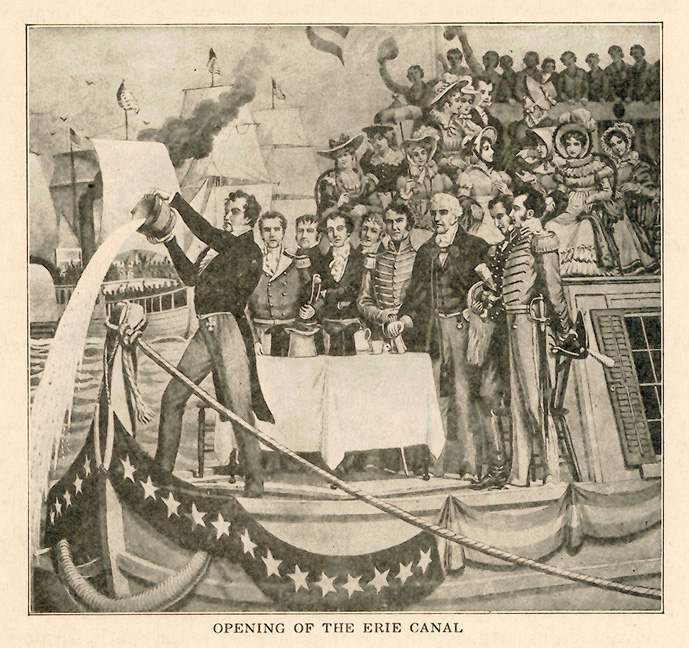
Image result for clinton wedding of the waters 

Prior to the canal's opening, it was cheaper to bring goods from Liverpool to New York than to haul them overland from Illinois. Once the canal was finished, not only did New York have access to plentiful raw materials from the Midwest, finished products could now also speed to the heartland, opening up new markets for the city's burgeoning manufacturing base. By the time of the Civil War, New York's control over shipping was so complete that nearly all the cotton being shipped from the south to Europe was being sent out of New York harbor rather than directly from southern ports.


* * *

Want to hear more about NYC history?

Inside the Apple has recently been released for the first time as an audio book!

Visit Amazon or Audible to download today


Thursday, October 11, 2018

Postcard Thursday: The DAR

Image result for postcard daughters american revolution

On October 11, 1890, the Daughters of the American Revolution was founded. The organization was created as part of a wave of patriotic sentiment that gripped America after the Civil War. It was also, quite frankly, a way for white, native-born women to remind immigrants that America had literally been created by the ancestors of the DAR.

James walked around Lower Manhattan this year looking for plaques and markers that the DAR (and other, similar organizations) had placed around the Financial District to remind people of the area's Revolutionary history. You can read that story in Curbed at

https://ny.curbed.com/2018/3/28/17168160/new-york-city-walking-tour-historic-guidebooks-1909.

* * *

Want to hear more about NYC history?

Inside the Apple has recently been released for the first time as an audio book!

Visit Amazon or Audible to download today


Thursday, September 8, 2016

Postcard Thursday: Henry Hudson's 1609 arrival


As we've noted on this blog before, there is a disagreement among historians about when Henry Hudson arrived in New York Harbor and first spied Manhattan island and the river that would eventually bear his name.

September 13th is the day traditionally held to be New York's anniversary and back in 2009, it was on that date that the city celebrated its 400th birthday, complete with a royal visit from the Prince of Orange (now the King of Netherlands) and Princess Maxima.

In fact, Hudson was already in and around New York days earlier.

For the record, this probably isn't Henry Hudson
We have a detailed description of Hudson's voyage thanks to the journal of his first mate, Robert Juet. Here's Juet's entry for September 13:
The thirteenth, fair weather, the wind northerly. At seven of the clock in the morning, as the flood came we weighed, and turned four miles into the river. The tide being done we anchored. Then there came four canoes aboard: but we suffered none of them to come into our ship. . . .
So, yes it appears that on September 13, the Halve Maen sailed four miles into the river. (A river which would only come to be known as the Hudson many years later; for a great portion of New York's history it was called the North River.)

The day before (Sept. 12), Juet notes:
Very fair and hot....we turned into the river two leagues and anchored.
And here is Juet's entry for September 11:
The eleventh was fair and very hot weather. At one of the clock in the afternoon we weighed and went into the river, the wind at south south-west, little wind. Our soundings were seven, six, five, six, seven, eight, nine, ten, twelve, thirteen, and fourteen fathoms. Then it shoaled again, and came to five fathoms. Then we anchored, and saw that it was a very good harbor for all winds, and rode all night.


Thus, it would appear that on September 11, Hudson "went into the river" and anchored in the "very good harbor," which means that on September 11, 1609, the Halve Maen was at anchor somewhere in New York harbor. Today, of course, we cannot think of September 11 without turning to more recent New York City events, but there's still no reason not to commemorate Hudson on the day he actually sailed into the harbor.

Thursday, August 18, 2016

Postcard Thursday: The 19th Amendment


courtesy of the Library of Congress
On August 18, 1920, the Nineteenth Amendment to the Constitution was ratified, granting women the right to vote across America.

The postcard above dates from ca. 1913, and was just one of many tools used by suffrage activists to convince the general public that women deserved a say in electoral politics. Though women were granted the right to vote in Wyoming as early as 1869, the campaign to open up the polls to all women was a long, hard battle.

A group of men -- and a few women -- gather at a women's suffrage rally at Park Row in Lower Manhattan. (They are clustered around the statue of Benjamin Franklin that still sits in front of Pace University.) Image courtesy of the Library of Congress

Of course, on the other side, anti-suffrage activists had long waged a campaign to keep women from the voting booth. In this image from 1880 (below), the illustrator shows caricatures of "women dressing and interacting in society as men; drinking; voting for handsome candidates; driving ugly men from the polls; and a domestic scene showing a man taking care of children."

images courtesy of the Library of Congress

In 1915, the satirical magazine Puck took aim at men who opposed universal suffrage. If voting were opened to women, how many all-male bastions would be left?

The passage of the 19th Amendment was a major milestone, but as Slate recently pointed out, it didn't actual result in universal suffrage: poll taxes, literacy tests, and other barriers made it difficult for many women to exercise their rights.

* * * *

Friday, August 5, 2016

Postcard Thursday: The Black Tom Explosion


First of all -- thank you to everyone who turned out for our talk, "Exploring Hamilton's New York," at the New-York Historical Society last Friday. Around 400 people filled the main theater to hear us give a virtual tour of the city that Hamilton would have known in the late 17th and early 18th centuries. (Here we are wondering "who wore it better?" at the beginning of the talk.)

(Interested in an actual walking tour of Hamilton's city? We give those, too.)

Second -- yes, today is Friday. Postcard Thursday sometimes keeps a schedule all its own.


Last Saturday was the 100th anniversary of the Black Tom Explosion, when German saboteurs blew up a munitions depot in New Jersey. What does that have to do with the Statue of Liberty? Read on:

Sometimes when we are giving tours of Lower Manhattan people will tell us: "I remember climbing to the top of the torch of the Statue of Liberty." This is almost certainly a faulty memory; the torch has been closed to visitors since 1916.

There are many reasons torch access was shut down: 

1) it is very difficult to access; 2) it was never designed for tourists (indeed, none of the statue's interior was built to host millions of visitors, giving rise to many of the statue's structural problems of the last few decades); 3) the climb from the shoulder to the torch was done in near darkness.

But the major reason the torch closed was an explosion on the night of July 30, 1916, on Black Tom Island in New Jersey, where millions of pounds of ammunition was being stored by the National Storage Company and the Lehigh Valley Railroad for eventual shipment to allied forces in Europe. It was the largest explosion in modern history--the equivalent of a 5.5 earthquake--and was felt in five states: Connecticut, New York, New Jersey, Pennsylvania, and Maryland.

Black Tom Island was originally a small island between Liberty (then Bedloe's) Island and Jersey City. By 1916, landfill had connected the island to the New Jersey mainland, and it was used as a major freight depot by the Lehigh Valley Railroad.

On the evening of July 30, the night watchmen noticed that there were fires on the pier where Johnson Barge No. 17 was moored. (The barge--which held 100,000 pounds of TNT--turned out to be illegally berthed there in order to avoid port charges. Even had it been legally moored, it seems like that would have made little difference.)

When it became clear that the fires were too large for the night watchmen to fight on their own, the Jersey City fire department was called in; however, it was too dangerous for them to proceed and at 2:08 a.m. the first of a series of explosions rocked the island. Shrapnel and munitions were blasted in every direction; some lodged in the Statue of Liberty (which ultimately cost $100,000 to repair), some made it was far away as the Jersey City clock tower, stopping the clock at 2:12 a.m.

Almost everyone in Manhattan was awoken by the strength of the blast and there were numerous injuries, mostly from falling glass. As the head of the New York Plate Glass Insurance Company noted the next day, a million dollars of glass had rattled out of its casements in the city, mostly south of West 44th Street. (At least one person was injured from falling glass, however, at Third Avenue and 89th Street.)

At first, the guards at the pier were brought in for questioning, as it was believed that the smudge pots they'd lit to keep mosquitoes at bay had caused the fire. Soon, it became clear that the explosion was sabotage, and suspicion fell quickly on German agents living in the United States. Though the exact identities of the bombers were never known, the Mixed Claims Commission (set up after World War I to adjudicate claims against Germany) eventually decided to fine Germany $50 million for the explosion. The money was finally paid in 1979.

Meanwhile, the management of the Statue of Liberty decided that Lady Liberty's arm had been too weakened by the explosion to allow tourist traffic to continue to climb to the torch; the torch was never reopened.


(This post has been adapted from one that appeared on this blog on October 26, 2011.)


Thursday, May 26, 2016

Postcard Thursday: Happy Birthday, Brooklyn Bridge


Tuesday passed with very little fanfare, but it was the 133rd birthday of the Brooklyn Bridge, the first of the East River crossings to be built, and the focus of many books, films, and even an Italian gum. (And a full chapter in both Inside the Apple and Footprints in New York.)

May 24 also happens to be the birthday of Queen Victoria, and back in 1883 when the bridge opened, this conjunction of dates proved to be a problem.

Many of the thousands of workers who constructed the bridge between 1869 and 1883 were Irish and they had no great love for the queen. Victoria's ministers were seen as having obstructed aid to the Irish during the great potato famine (which began in 1845) and rumors circulated that the queen had donated only £5 to the Irish -- and on the same day she'd given the same amount to a dog shelter. That wasn't true, but it didn't matter much to New York's large Irish population, who tried to persuade the city to postpone the bridge's opening ceremonies to a different day. The city refused but then began to worry that the bridge workers would cause a disturbance and had to pay for extra police to quell any possible riots.

The grand opening -- an elaborate ceremony that included President Chester A. Arthur, Governor Grover Cleveland, and the mayors of New York and Brooklyn (then still independent cities) -- went smoothly with no violence. Indeed, the biggest problem came a week later when a throng of pedestrians (who had paid a penny each to cross the span) got scared and cried out that the bridge was collapsing, In the ensuing melee, a dozen people were trampled to death.

There's a chapter in Footprints about Seth Low that goes into much greater detail about the bridge's opening day that's worth a look.

LAST CHANCE!

RESERVATIONS ARE ALMOST FILLED UP
for our 3rd Annual Alexander Hamilton Memorial Day Weekend Walk

Read all about it and reserve at


Search This Blog

Blog Archive