GET UPDATES IN YOUR INBOX! Subscribe to our SPAM-free updates here:

GET UPDATES IN YOUR INBOX! Subscribe to our SPAM-free email here:

Delivered by FeedBurner

Thursday, October 25, 2018

Postcard Thursday: The Erie Canal

I've got an old mule and her name is Sal
Fifteen years on the Erie Canal
She's a good old worker and a good old pal
Fifteen years on the Erie Canal
We've hauled some barges in our day
Filled with lumber, coal, and hay
And every inch of the way we know
From Albany to Buffalo


-- From "Low Bridge Everybody Down" aka "Erie Canal"

from the collection of the New-York Historical Society

On October 26, 1825, one of the most important engineering feats of the 19th century was completed with the opening of the Erie Canal. A cannon was fired in Buffalo to mark the moment. Then, a series of cannons along the canal and the Hudson River had been set up for the occasion and as each gunner heard the shot, he fired his own; in 90 minutes the news passed, cannon to cannon, along the waterway to New York City.

Ten days later, New York's governor, DeWitt Clinton, stood on the deck of a packet boat anchored off Sandy Hook and poured a barrel of water from Lake Erie into the Atlantic Ocean. This "wedding of the waters," as it came to be known, was the symbolic completion of the Erie Canal, the most important waterway of its day and the engineering project that once and for all sealed New York's fate as the most important commercial city in America.

An entire chapter of Footprints in New York is dedicated to Governor (and NYC mayor) Clinton, the unsung hero of 19th-century New York politics. As we write in the book, Clinton
was the most important politician of his generation—perhaps the most important politician New York has ever had—which, considering the company, is quite an achievement. 
Clinton was New York’s junior senator; then, he served ten one-year terms as the city’s mayor between 1803 and 1815. Later, as governor, he oversaw the building of the Erie Canal, the biggest engineering project of its day, which radically transformed New York’s economy. Had Clinton carried the state of Pennsylvania in the election of 1812—which he nearly did—he would have been president of the United States, and might have brought a quick resolution to the war with Great Britain. 
Clinton’s influence is incalculable. From expanding trade through the Erie Canal to overseeing the real estate revolution embodied in the city’s rigid grid plan, the effects of Clinton’s years in politics are still felt today by every New Yorker. 
On November 4, 1825, in a ceremony for dignitaries and the press, Governor Clinton poured a small cask of water into the Atlantic Ocean. An artist captured the moment: Clinton stands on the edge of a barge, the miniature cask grasped in his hands, as the water—collected ten days earlier in Lake Erie—gracefully cascades into the sea.
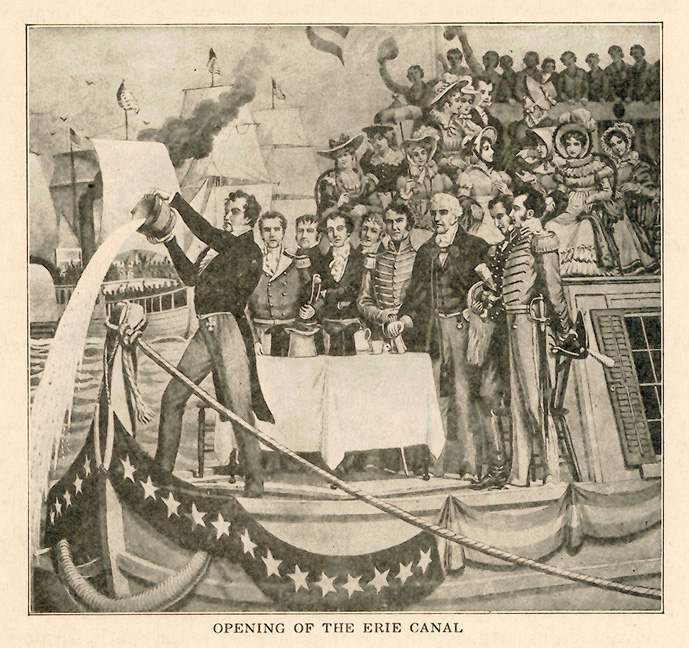
Image result for clinton wedding of the waters 

Prior to the canal's opening, it was cheaper to bring goods from Liverpool to New York than to haul them overland from Illinois. Once the canal was finished, not only did New York have access to plentiful raw materials from the Midwest, finished products could now also speed to the heartland, opening up new markets for the city's burgeoning manufacturing base. By the time of the Civil War, New York's control over shipping was so complete that nearly all the cotton being shipped from the south to Europe was being sent out of New York harbor rather than directly from southern ports.


* * *

Want to hear more about NYC history?

Inside the Apple has recently been released for the first time as an audio book!

Visit Amazon or Audible to download today


Thursday, October 18, 2018

Postcard Thursday: Melville's Whale

site for processing whale oil, Antarctica
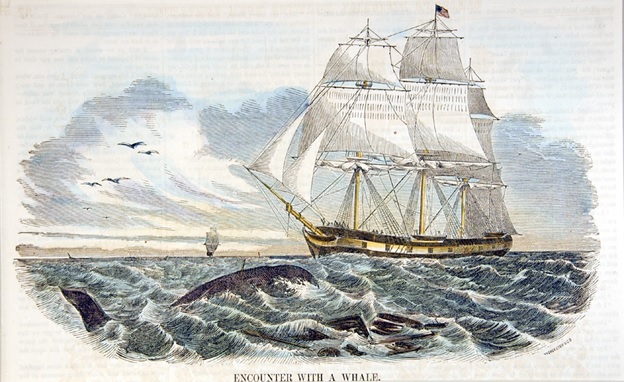
On October 18, 1851, a novel called The Whale by Herman Melville was published in England. It would come out in America about a month later under the title Moby Dick and would become a landmark of 19th-century American literature. (Though not immediately -- the first edition was a failure.)

Melville was born in Lower Manhattan and -- when he wasn't working on square-rigged sailing ships -- spent most of his life in the city.
"There now is your insular city of the Manhattoes, belted round by wharves as Indian isles by coral reefs—commerce surrounds it with her surf. Right and left, the streets take you waterward…. Circumambulate the city of a dreamy Sabbath afternoon. Go from Corlears Hook to Coenties Slip, and from thence, by Whitehall, northward. What do you see?—Posted like silent sentinels all around the town, stand thousands upon thousands of mortal men fixed in ocean reveries."
-- Herman Melville, Moby Dick


For years, there was a bust of Melville inset into the wall behind 17 State Street, a 1988 office tower built by Emory Roth & Sons in the Financial District. The bust marked the spot (sort of) where Melville was born at 6 Pearl Street.

However, a recent renovation of the plaza has erased the Melville memorial. Do any readers know what happened to the bust? We've reached out to the leasing agent for the building, but so far have not heard back.

Image result for whaling ships

* * *

Want to hear more about NYC history?

Inside the Apple has recently been released for the first time as an audio book!

Visit Amazon or Audible to download today

Thursday, October 11, 2018

Postcard Thursday: The DAR

Image result for postcard daughters american revolution

On October 11, 1890, the Daughters of the American Revolution was founded. The organization was created as part of a wave of patriotic sentiment that gripped America after the Civil War. It was also, quite frankly, a way for white, native-born women to remind immigrants that America had literally been created by the ancestors of the DAR.

James walked around Lower Manhattan this year looking for plaques and markers that the DAR (and other, similar organizations) had placed around the Financial District to remind people of the area's Revolutionary history. You can read that story in Curbed at

https://ny.curbed.com/2018/3/28/17168160/new-york-city-walking-tour-historic-guidebooks-1909.

* * *

Want to hear more about NYC history?

Inside the Apple has recently been released for the first time as an audio book!

Visit Amazon or Audible to download today


Thursday, October 4, 2018

Postcard Thursday: Reminder -- Sun Oct 7, Gilded Age Walking Tour

NEW YORK IN THE GILDED AGE
WALKING TOUR
 

Sunday, October 7, at 11:00 a.m.

Come Explore Beaux-Arts Grandeur


Authors James and Michelle Nevius have been exploring New York and writing about the city for many years. This week, James had a story in The New York Post about the rivalry between Chicago and New York brought about by the 1893 World's Columbian Exposition, also known as the "White City" World's Fair.

This Columbus Day weekend, celebrate the 125th anniversary of the fair and the architectural movement it helped create, by joining James and Michelle for a guided walk in Midtown Manhattan of some of the iconic landmarks from this Beaux-Arts boom.

New York between 1893 and 1913 remade itself as the "Paris of America" and the true world city. From the Broadway theaters that moved to Times Square at the turn of the 20th century to giant public spaces like Grand Central Terminal and the New York Public Library, this tour will feature some of the best Gilded-Age architecture in the city.
  • $15 per person for blog readers. Please register ASAP as space is limited.

REGISTER NOW

  • Your name
  • The number in your party
  • A cell phone in case we need to reach you the day of the tour
MEETING PLACE WILL BE SENT WITHIN 24 HOUR OF RECEIVING YOUR RESERVATION
(use the button below or email walknyc@gmail.com)
SIGN UP NOW

STAY INFORMED

F O L L O W on F A C E B O O K
F O L L O W on T W I T T E R
F O L L O W on I N S T A G R A M
Times Square at the turn of the 20th Century

Thursday, September 27, 2018

Postcard Thursday: Wall Street

Image result for slave market wall street

For nearly four centuries, the lower tip of Manhattan has been defined by Wall Street, the path of which was originally marked by a nine-foot-high wooden palisade.

James digs deep into the the street's history for Curbed NY in his most recent feature story, which you can read here: https://ny.curbed.com/2018/9/26/17900962/wall-street-new-york-city-history.

* * *

REMINDER: On Sunday, October 7, at 11:00AM, we will be guiding a tour of Gilded-Age New York. All the details are at http://blog.insidetheapple.net/2018/09/postcard-thursday-gilded-age-walking.html. There are only a few spots left at just $15 a piece -- book now!

* * *

Want to hear more about NYC history?

Inside the Apple has recently been released for the first time as an audio book!

Visit Amazon or Audible to download today


Thursday, September 20, 2018

Postcard Thursday: Gilded Age Walking Tour -- Oct 7 at 11:00am

NEW YORK IN THE GILDED AGE
WALKING TOUR
 

Sunday, October 7, at 11:00 a.m.

Come Explore Beaux-Arts Grandeur


Authors James and Michelle Nevius have been exploring New York and writing about the city for many years. This week, James had a story in The New York Post about the rivalry between Chicago and New York brought about by the 1893 World's Columbian Exposition, also known as the "White City" World's Fair.

This Columbus Day weekend, celebrate the 125th anniversary of the fair and the architectural movement it helped create, by joining James and Michelle for a guided walk in Midtown Manhattan of some of the iconic landmarks from this Beaux-Arts boom.

New York between 1893 and 1913 remade itself as the "Paris of America" and the true world city. From the Broadway theaters that moved to Times Square at the turn of the 20th century to giant public spaces like Grand Central Terminal and the New York Public Library, this tour will feature some of the best Gilded-Age architecture in the city.
  • $15 per person for blog readers. Please register ASAP as space is limited.

REGISTER NOW

  • Your name
  • The number in your party
  • A cell phone in case we need to reach you the day of the tour
MEETING PLACE WILL BE SENT WITHIN 24 HOUR OF RECEIVING YOUR RESERVATION
(use the button below or email walknyc@gmail.com)
SIGN UP NOW

STAY INFORMED

F O L L O W on F A C E B O O K
F O L L O W on T W I T T E R
F O L L O W on I N S T A G R A M
Times Square at the turn of the 20th Century

Wednesday, September 12, 2018

Postcard Thursday: The Death of General Wolfe

The Death of General Wolfe by Benjamin West.

On September 13, 1759, Major-General James Wolfe died during the Siege of Quebec in the French and Indian War (aka the Seven Years War). Wolfe's heroic victory won the war for Britain, allowing it to seize most of Atlantic Canada, and made Wolfe both a martyr to the cause and an instant celebrity.

The most famous commemoration of Wolfe's death on the Plains of Abraham is Benjamin West's painting (above), now in the National Gallery of Canada. But New York had its own memorial to General Wolfe, an obelisk that was erected in Greenwich Village at the end of what came to be known as "Obelisk Lane" or "Monument Lane."

The General Wolfe monument at Stowe.

Very little is known about the memorial. Some think that it was based on a similar obelisk erected in Stowe in Buckinghamshire, England, by Lord Temple, which still stands today. But this is just speculation. Indeed, if it weren't for a few old memoirs and a couple of maps, we wouldn't know that the monument existed at all.

Montressor Map, ca. 1765-1766.

The obelisk was likely erected soon after Wolfe's death, probably in 1762 by Robert Monckton. Monckton was Wolfe's second in command at Quebec and in 1762 he became royal governor of the Province of New York. He lived in Greenwich Village, in a house owned by Admiral Peter Warren, which stood only a few minutes walk from the monument.

The obelisk appears on the Montressor map of 1765-66, where a "Road to the Obelisk" leads to a spot just east of Oliver De Lancey's farm marked "Obelisk Erected to the Memory of General Wolf [sic] and Others."

The Ratzer Plan, ca. 1766-77
The Ratzer Plan of the city -- issued in 1766 or 1777 -- shows a similar road, calling it "The Monument Lane." If you are familiar with this part of Greenwich VIllage, that lane is now Greenwich Avenue, which runs northwest from Sixth Avenue just south of Christopher Street. However, many other small streets in the Village were once considered part of the lane. As the American Scenic and Historic Preservation Society wrote in their annual report of 1914:
Monument Lane began at the present Fourth Avenue and Astor Place and ran westward along the present Astor Place; thence to Washington Square North about 100 feet west of Fifth Avenue, where it crossed a brook called at various times Minetta Brook, Bestevaer's Kill, etc.; thence to the present Sixth Avenue and Greenwich Lane; thence along the present Greenwich Lane to Eighth Avenue between Thirteenth and Fourteenth Streets, where it intersected the now obsolete Southampton Road; thence northward about 150 or 200 feet farther, where it terminated at the Monument.
Tracing those roads today, it seems likely that the road probably incorporated what today is Washington Mews and MacDougal Alley, just north of Washington Square, roads that have long been thought to be Native American trails. Indeed, it would not be at all surprising to discover that all of Monument Lane existed long before Europeans settled the area that would come to be known as Greenwich Village.

No one is entirely sure when the monument to General Wolfe was taken down and by whom, but by the time the next map of Manhattan was drawn, ca. 1773, the monument is gone and references to Monument Lane disappear soon thereafter. Some speculate that Oliver De Lancey, a loyalist, destroyed the monument when his lands were confiscated by the Americans after the war, but it seems more likely that the obelisk was already long gone by that time.

(This post was adapted and updated from an earlier blog entry.)


* * *

Want to hear more about NYC history?

Inside the Apple has recently been released for the first time as an audio book!

Visit Amazon or Audible to download today


Thursday, September 6, 2018

Postcard Thursday: Greetings from Saint Augustine!


The oldest Roman Catholic parish in America is the one headquartered at the basilica cathedral in Saint Augustine, Florida. The parish was founded in 1565; its current church dates back to the 1790s, but it has burned many times. After the fire of 1887, the diocese hired James Renwick, Jr. -- of St. Patrick's Cathedral fame -- to oversee the restorations. This bell tower was added following Renwick's designs.

James wrote a story for The New York Post about Renwick's New York domestic work -- you can read it at:

https://nypost.com/2018/06/06/the-secret-legacy-of-the-architect-behind-st-patricks/

* * *

Want to hear more about NYC history?

Inside the Apple has recently been released for the first time as an audio book!

Visit Amazon or Audible to download today


Thursday, August 23, 2018

Postcard Thursday: Trinity's Real Estate Empire

Image result for postcard trinity church wall street
looking up Wall Street at Trinity Church

Yesterday, James had a feature in Curbed NY about the history of Trinity Church's real estate holdings in Lower Manhattan. By the end of the nineteenth century, Trinity had become the second-largest land owners in New York City, but much of what they owned in the area now know as Tribeca was actually in terrible shape. Trinity was called out by the local press as one of the city's biggest slumlords and it became a huge scandal.

(This area has been in the news recently because Disney is going to be building a new headquarters on some of Trinity's land in what was once the center of this slum.)

The whole story is fascinating:

an artist's rendition of what the original Trinity looked like ca. 1698

* * *

Want to hear more about NYC history?

Inside the Apple has recently been released for the first time as an audio book!

Visit Amazon or Audible to download today

Thursday, August 9, 2018

Postcard Thursday: An Assassination Attempt Caught on Camera


On August 9, 1910, the mayor of New York, William Jay Gaynor, posed for photos on the deck on the SS Kaiser Wilhelm der Grosse. He was about to embark on a vacation to Europe, and as he stood on deck he was approached by J.J. Gallagher, a former municipal dock worker who had been fired about a month earlier. Gallagher shot the mayor at close range--just as New York World photographer William Warnecke snapped the picture above. Gallagher was immediately subdued. When asked why he'd done it, Gallagher said simply: "He took away my bread and meat. I had to do it."

Mayor Gaynor, a native of the village of Oriskany in Oneida County, was best known as a jurist, having been appointed to State's Supreme Court in 1893 and the Appellate Division in 1905. Tammany Hall Democrats, disappointed by their two-term standard bearer, George B. "Max" McClellan, picked Gaynor to run in 1909. Gaynor handily defeated the Republic/Fusion candidate, Otto T. Bannard, in part because Republican votes were siphoned off by newspaper magnate William Randolph Hearst who ran as an independent.

Instead of appointing Tammany Hall cronies to fill vacancies at City Hall, however, Gaynor instituted broad-reaching civil service reforms and was a champion of extending the new IRT subway. 

Though the bullet lodged in Mayor Gaynor's throat, he made a relatively speedy recovery. (Gallagher, meanwhile, was tried, found insane, and sent to an asylum in Trenton, New Jersey.)

In 1913, Gaynor received the backing of a reform coalition to run for a second term as mayor. (Tammany Hall wanted nothing more to do with him.) On September 3, he left for Europe on the SS Baltic and six days later, he died in a deck chair of a heart attack; it is unclear whether or not Gallagher's assassination attempt had weakened the mayor and contributed to his death. Gallagher was never tried with murder--he had died at the Trenton asylum a few months earlier.

Very few New York City mayors are honored in our parks, but if you happen to be in Brooklyn Heights, head to Cadman Plaza where you'll find the handsome Gaynor Memorial by Adolph Weinman. (Weinman is best known in New York for his statue Civic Fame which stands atop the Municipal Building on Centre Street.)


* * *

Want to hear more about NYC history?

Inside the Apple has recently been released for the first time as an audio book!

Visit Amazon or Audible to download today

Search This Blog

Blog Archive